
Last Updated on September 21, 2026
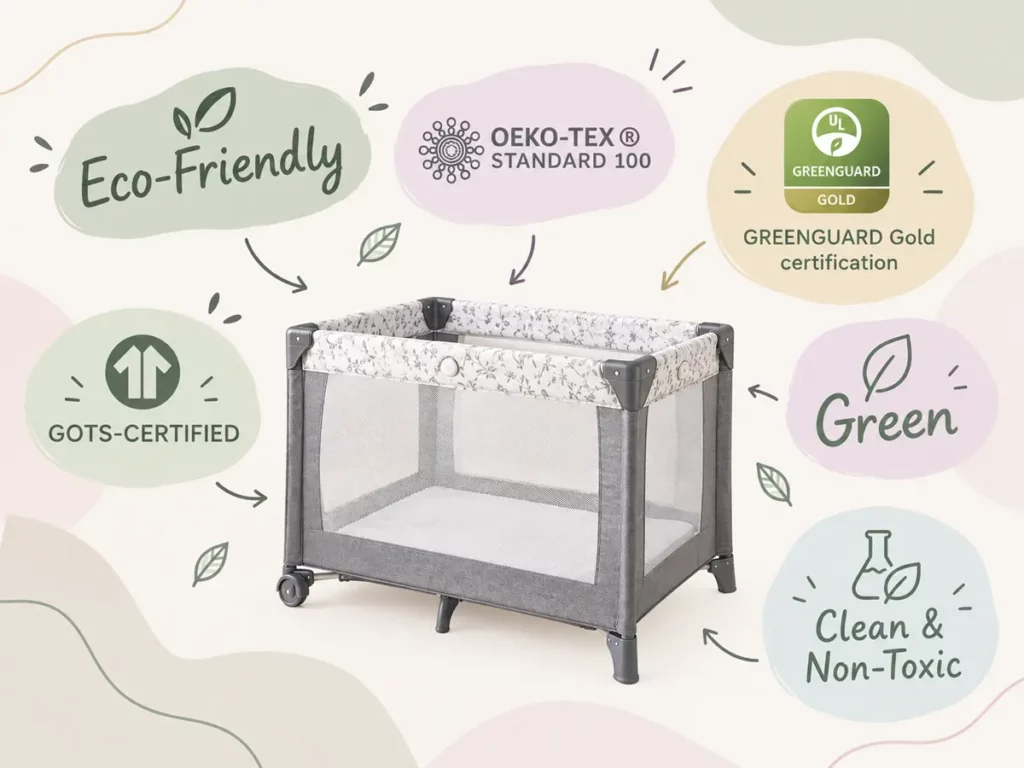
Trying to choose a more eco-friendly playard? The labels can get confusing fast. Organic cotton, recycled fabrics, GREENGUARD Gold — what do these terms actually mean, and which ones are worth looking for?
The good news is that you don’t need to understand every material used in a playard. A few simple details can help you make a more informed choice without spending hours researching.
What Makes a Playard Eco-Friendly?
An eco-friendly playard is one that uses materials or manufacturing practices intended to reduce its environmental impact. This might include using recycled or organic materials, reducing waste, or making a product durable enough to last a long time.
You may also see terms such as “green,” “clean,” or “non-toxic” used alongside environmental claims. These terms don’t all mean the same thing.
A product can have low chemical emissions without being made from recycled or organic materials. Likewise, a recycled material isn’t automatically safer in terms of chemical exposure. These labels answer different questions.
When choosing a playard, look beyond broad labels and check the specific materials, certifications, and environmental claims provided by the manufacturer
Look at How the Playard Is Made
Before getting into specific materials, it helps to look at the different parts of a playard. Not every part will use the same material, and some may contain recycled or organic materials while others do not.
Looking at these parts separately makes it easier to see where recycled, organic, or other environmentally conscious materials are actually being used.
Best Eco-Friendly Playard Materials
If you’re comparing playards based on their materials, these are some of the most useful options to look for. The right choice depends on which part of the playard you’re looking at, since the frame, fabrics, mesh, and other components may all use different materials.
1. GOTS-Certified Organic Cotton
GOTS-certified organic cotton is one of the most useful materials to look for in playard textiles.
GOTS stands for Global Organic Textile Standard. It covers organic fibers as well as how the textile is processed and manufactured.
For playards, you’ll most often find organic cotton in fitted sheets, mattress covers, or other removable fabrics rather than in the entire playard.
That makes an organic cotton sheet one of the easiest ways to add an eco-conscious material to your baby’s playard.
One important distinction: “organic cotton” and “GOTS-certified organic cotton” are not necessarily the same thing. If the certification matters to you, look for the actual GOTS certification rather than relying only on the words “organic cotton.”
2. Recycled Polyester
Recycled polyester is another material you may see in baby gear.
Instead of making all the polyester from newly produced plastic, recycled polyester can be made from existing plastic materials, including recycled bottles.
In playards, it is most commonly used in mesh side panels, fabric covers, mattress covers, carrying bags, and other textiles rather than in the frame itself.
Some manufacturers use recycled polyester in only certain parts of a product. So when you see a claim such as “made with recycled materials,” check the product details to see exactly which part contains them.
3. Other Recycled Synthetic Fabrics
You may also come across recycled nylon or other recycled synthetic fibers.
These materials can be used in mesh sides, fabric panels, carrying bags, and other removable textiles.
You don’t necessarily need to choose one recycled fabric over another. Instead, look for clear information about what material is recycled and how much of the product uses it.
A specific claim such as “100% recycled fabric” tells you much more than a general statement that a product contains “eco-friendly materials.”
4. Recycled Plastics and Metals
Eco-friendly material claims aren’t limited to fabrics. Some manufacturers may also use recycled plastic or recycled metal in parts of the frame, connectors, feet, or other components.
If you see this type of claim, check exactly which part of the playard contains recycled material. A playard made with some recycled plastic or metal isn’t necessarily made mostly from recycled materials.
The same applies to metal frames. Steel and aluminum can be recycled, but simply having a metal frame doesn’t automatically make a playard an eco-friendly product.
Specific information about the material and the percentage or amount of recycled content is much more useful than a general “green” claim.
Durable, Washable Materials
Sustainability isn’t only about whether a material is recycled or organic.
A playard that is made to last, can be cleaned easily, and doesn’t need to be replaced quickly may also be a more practical choice.
Look at the fabric panels, sleep surface cover, plastic components, and frame. Does the manufacturer explain what they are made from? Are the fabrics washable? Are care instructions available? Can you get replacement parts if something wears out?
A durable playard that stays useful for years can be a more eco-conscious choice than one that needs to be replaced frequently, even if the newer product has a longer list of “green” claims.
What These Eco-Friendly Materials Look Like in Real Playards
It can be hard to tell what an “eco-friendly” material claim actually means until you look at a real product. Here are two examples that show why it’s important to check the details.
Maxi-Cosi Swift Play Yard: Recycled Fabric
The Maxi-Cosi Swift Play Yard is a good example of a playard that uses recycled material in its fabrics. Its EcoCare fabric is made from 100% recycled plastic bottles.
That doesn’t mean the entire playard is made from recycled materials. The recycled content refers to the fabric, while the playard also has a separate frame, mattress, and other components.
This is the kind of specific claim that is more useful than simply calling a playard “eco-friendly.”
UPPAbaby REMI: GREENGUARD Gold + Organic Cotton
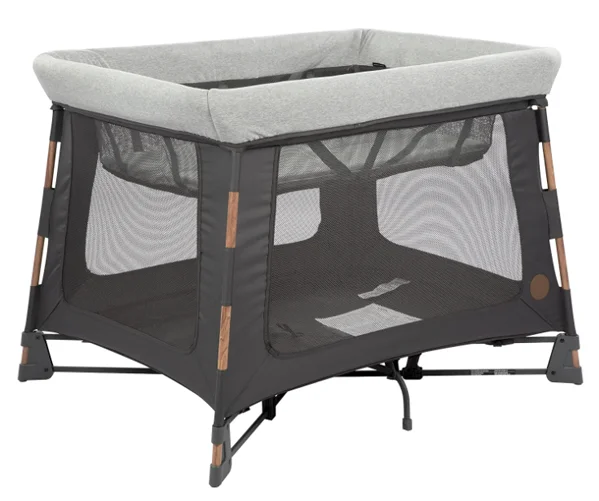
The UPPAbaby REMI Playard is a good example of how different material and environmental claims can apply to different parts of the same product.
The REMI has GREENGUARD Gold Certification, which addresses chemical emissions. It also comes with an organic cotton mattress cover.
The distinction is important: the organic cotton refers to the mattress cover, not to the entire playard. The REMI itself uses several different materials, including an air-mesh mattress and other components.

UPPAbaby Remi 3-in-1 Portable Playard
So when a playard has several “green” features, look at exactly what the certification or material claim applies to rather than assuming it applies to the whole product.
Look for Specific Environmental Claims
Pay attention to how specific the manufacturer’s claims are. “Eco-friendly,” “green,” and “clean” don’t tell you very much on their own.
More useful information might tell you:
- What material is recycled
- What percentage is recycled
- Whether cotton is certified organic
- Which specific product is certified
- Which parts of the playard use the material
- How the materials should be cared for
The more specific the information, the easier it is to understand what you’re actually buying.
Other Things to Look For in an Eco-Friendly Playard
Materials are only part of the picture. These certifications can help you answer different questions about the product.
1. GREENGUARD Gold
GREENGUARD Gold is not a material. It is a certification for low chemical emissions.
In simple terms, it helps identify products that meet strict limits for certain chemical emissions into indoor air.
Some playards and travel cribs have this certification. If it matters to you, make sure it applies to the specific playard model you’re considering.
GREENGUARD Gold doesn’t mean the playard is made from organic or recycled materials. It answers a different question: how much certain chemicals the product emits.
2. OEKO-TEX STANDARD 100
OEKO-TEX STANDARD 100 is another certification you may see on playard sheets and other textiles.
It tests textiles and their components for a long list of potentially harmful substances. The requirements are stricter for products intended for babies and young children.
This makes OEKO-TEX particularly useful when you’re shopping for fitted sheets or other fabrics that touch your baby.
Like GREENGUARD Gold, it doesn’t mean the fabric is organic or recycled. It is a textile-testing certification.
Your Eco-Friendly Playard Checklist
You don’t need a playard with every green label available. Look for the things that matter most to you.
Important: An eco-friendly material should never be a reason to compromise on safety.
Any playard you use should meet the applicable U.S. safety requirements for playards. If you can’t verify that a product meets the required safety standards, I wouldn’t use it for your baby.
Another important safety rule: Don’t add a separate mattress, topper, or extra padding to make a playard more comfortable or “greener.” Use the sleep surface supplied or specified by the manufacturer.
Already Have a Playard? Start With the Sheet.
You don’t have to replace a perfectly good playard just because it isn’t marketed as eco-friendly. In fact, replacing a playard that is still safe and useful just to buy one with “greener” materials can create more waste rather than less.
If you simply want to reduce the number of less eco-friendly materials that come into contact with your baby, start with the sheet. One option is a GOTS-certified organic cotton fitted sheet. A sheet is one of the easiest parts of a playard to replace, and it is one of the materials that comes directly in contact with your baby’s skin.
Just make sure the sheet is designed for the size and model of your playard and fits properly. A sheet should never be used if it is loose, oversized, or not intended for that particular sleep surface.
It’s a small change, but you don’t have to replace an entire piece of baby gear to make a more eco-conscious choice.
The Bottom Line
Choosing a more eco-friendly playard doesn’t have to be complicated.
Start by looking at what the different parts are made of. GOTS-certified organic cotton can be a good choice for sheets and other textiles, while recycled polyester and other recycled fabrics may be used in mesh, fabric panels, covers, and bags.
Then look at certifications such as GREENGUARD Gold and OEKO-TEX STANDARD 100 if chemical emissions or textile testing are important to you.
You don’t need every label. The goal is simply to understand what you’re buying and choose the features that matter most to your family.