
What’s the Real Difference — and Which Should You Choose?
· Updated for 2026 ·
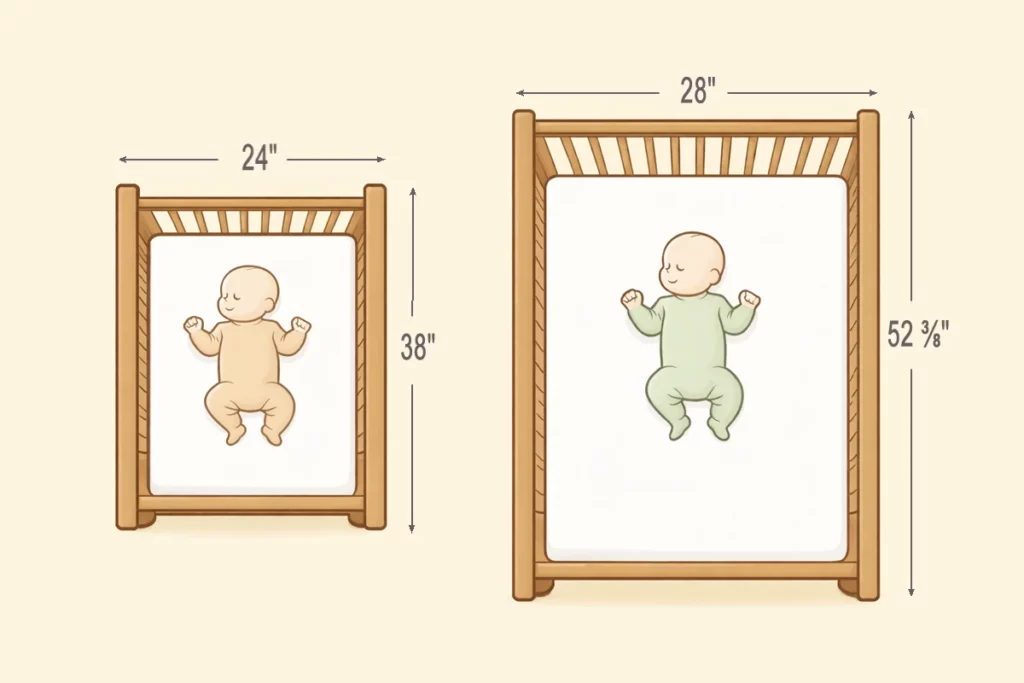
Choosing between a mini crib and a standard crib seems straightforward—until you actually try to fit one into your home and daily life.
If you live in a small apartment, plan to room-share with your baby, or want to avoid buying multiple sleep setups during the first few years, this decision matters more than you think. We’ve tested different crib types, compared dimensions, and analyzed real parent feedback to answer one key question honestly: Is a mini crib truly enough, or is a standard crib still the better long-term choice?
The answer isn’t universal. It depends on your space, your plans, and how long you expect the crib to last.
- Mini Crib vs. Standard Crib: Which One Should You Choose?
- Mini Crib vs. Standard Crib
- Crib Size: The Real Difference
- Mini Crib vs. Standard Crib Longevity: How Long Can You Use Each?
- Convertibility: Mini vs. Standard Cribs
- Portability: Where Mini Cribs Clearly Win
- Are Mini Cribs as Safe as Standard Cribs?
- Mini Crib vs. Standard Crib: Pros and Cons
- Frequently Asked Questions: Mini Crib vs. Standard Crib
- Cost Over Time: Which Crib Is the Better Investment?
- Bottom Line
👉 If you’re still in the early research phase, you may also want to start with our complete Crib Buying Guide.
Mini Crib vs. Standard Crib: Which One Should You Choose?
Quick answer: The right choice depends on your space, how long you want the crib to last, and whether this will be your baby’s primary sleep setup.
Choose a mini crib if:
- You live in a small apartment or have limited nursery space
- You plan to room-share beyond the newborn stage
- You want a sturdier, longer-lasting alternative to a bassinet
- You need a secondary crib (grandparents’ home, shared custody, caregivers)
Choose a standard crib if:
- Space isn’t an issue
- You want one bed to last from infancy through toddlerhood
- You prefer maximum stability and mattress availability
- You don’t want to replace or upgrade the crib later
Real-Life Scenarios: Which Crib Fits Your Situation?
In a smaller apartment, every square foot matters. A full-size crib can quickly dominate the bedroom or nursery, leaving little room for a dresser, a rocking chair, or even comfortable walking space.
In this situation, a mini crib often makes daily life easier. It provides a safe sleep space without overwhelming the room. For many apartment-dwelling families, it’s the difference between a functional layout and a cramped one.
If you’re planning to move within the next year or two, a mini crib can also serve as a temporary but practical solution before transitioning to a larger setup.
A 9×10 nursery may sound spacious on paper, but once you add a dresser, closet access, storage bins, and a comfortable chair, the space fills up quickly.
A standard crib will fit — but it may limit furniture placement options. A mini crib, on the other hand, allows more flexibility in layout and often makes the room feel more open.
Parents who want space for a glider or additional storage frequently find that a mini crib gives them more design freedom without compromising safety.
If your long-term plan is to transition your toddler to a Montessori-style floor bed around 12–18 months, a mini crib can make a lot of sense.
Since you don’t intend to use the crib for 3+ years, investing in a full-size convertible crib may not provide much added value. A mini crib can comfortably cover the first year or so before you move to a floor bed setup.
In this case, longevity isn’t the priority — flexibility is.
Mini Crib vs. Standard Crib
Here is a side-by-side comparison of a mini and a full-size crib:
| Feature | Mini Crib | Standard Crib |
|---|---|---|
| Typical interior size | ~38″ x 24″ (varies by model) | 52 ⅜” x 28″ (regulated) |
| Size regulation | Not standardized | Government regulated |
| How long it’s usable | ~12–24 months (crib mode) | 2–3+ years (crib mode) |
| Room-sharing friendly | Excellent | Depends on room size |
| Portability | Very easy, often on wheels | Limited |
| Mattress availability | Good, size-specific | Very easy |
| Convertibility options | Daybed, twin bed | Toddler bed, daybed, full-size bed |
| Toddler guardrail option | Rare | Yes |
| Overall stability | Lighter build | Heavier and sturdier |
| Best for | Small homes, secondary cribs | Long-term primary sleep setup |
Crib Size: The Real Difference
The size, or more precisely, the footprint, is the biggest and most noticeable difference between a mini crib and a standard crib.
It’s also the reason most parents even start considering a mini crib in the first place. They’re trying to figure out whether a smaller crib will work in their space — and whether it’s just as good as a full-size option.
Interior dimensions refer to the actual sleep space inside the crib. These measurements determine:
- What size mattress you’ll need
- How much room your baby has to stretch, roll, and move
1. Standard Crib Size (U.S. regulated)
Full-size cribs sold in the United States are federally regulated under 16 CFR Part 1219, which sets mandatory interior size requirements. Interior dimensions must measure:
- 52 3/8 ± 5/8 inches (133 ± 1.6 cm) long
- 28 ± 5/8 inches (71 ± 1.6 cm) wide
Because of this regulation, mattress sizing is consistent across brands.
2. Mini Crib Size (Not federally standardized)
Mini cribs are defined as any crib with interior dimensions smaller than:
- 49 ¾ inches (126.3 cm) in length
- 25 ⅜ inches (64.3 cm) in width
- Or both
However, most mini cribs on the market measure approximately:
- 38 inches long
- 24 inches wide
While not legally standardized, manufacturers have largely aligned around these dimensions.
The exterior dimensions are the crib’s overall footprint — the total space it takes up in your room. These measurements depend on the thickness and design of the frame.
In general:
- Mini cribs have slimmer, more minimalist frames. Many are portable, foldable, or designed specifically for small rooms and shared spaces.
- Standard cribs, especially traditional or convertible models, often have bulkier frames built for long-term durability and multiple conversion stages.
💡 Even if a crib technically “fits,” remember to account for walking paths, dressers, changing tables, storage, and seating. A nursery that looks spacious on paper can feel cramped in real life.
Getting the right mattress size for your baby’s crib is one of the most important crib safety factors. You want that mattress to fit nice and snug — no big gaps around the edges where little hands or feet could get stuck.
In the U.S., there are strict federal rules about the size of full-size cribs and crib mattresses. So any standard crib mattress you buy is designed to fit securely in any standard full-size crib. That takes a lot of the guesswork out of it.
But mini cribs are a different story. They don’t have a federally regulated size, so even though most are about 38 x 24 inches, there’s a little more variety from brand to brand.
💡 Note: Always double-check both the exact measurements of your mini crib and the mini crib mattress before you buy. Even a small gap can be a safety issue, so it’s worth taking an extra minute to be sure everything lines up.
Mattress fit doesn’t stop at the mattress itself — crib sheets matter just as much.
For standard cribs, sheet sizing is simple due to regulated mattress dimensions.
For mini cribs, sheet sizing can vary slightly depending on the mattress brand. Some mini mattresses are slightly narrower or shorter than others, which may require brand-specific sheets for a secure fit.
💡 Never use standard crib sheets on a mini crib mattress. Loose fabric can bunch up and increase suffocation risk.
Mini Crib vs. Standard Crib Longevity: How Long Can You Use Each?
One of the main trade-offs with a mini crib is longevity. While it saves space, most babies use a mini crib comfortably until around 12 to 18 months. Some outgrow it closer to their first birthday, while others may fit until about age two. It really depends on their height and activity level.
A full-size standard crib typically lasts longer in crib mode. Many children use it from birth until around 2.5 to 3 years old.
Most manufacturers recommend stopping crib use once a child reaches 35 inches in height or starts attempting to climb out. This guideline generally applies to both mini and standard cribs.
If the crib is convertible, the toddler bed stage can extend usability to around 3 to 4 years, and full-size bed conversions can last well into childhood.
While weight limits vary by model, height and climbing behavior are usually the more important safety factors to monitor.
Convertibility: Mini vs. Standard Cribs
When parents hear the word convertible, it often sounds like a guarantee that the crib will last forever. In reality, convertibility varies a lot by model — especially between mini and full-size cribs.
Full-Size Crib Convertibility
Full-size cribs offer the widest range of conversion options. Many convert from a crib into a toddler bed (sometimes with a guardrail included, sometimes sold separately), then into a daybed, and eventually into a full-size bed.
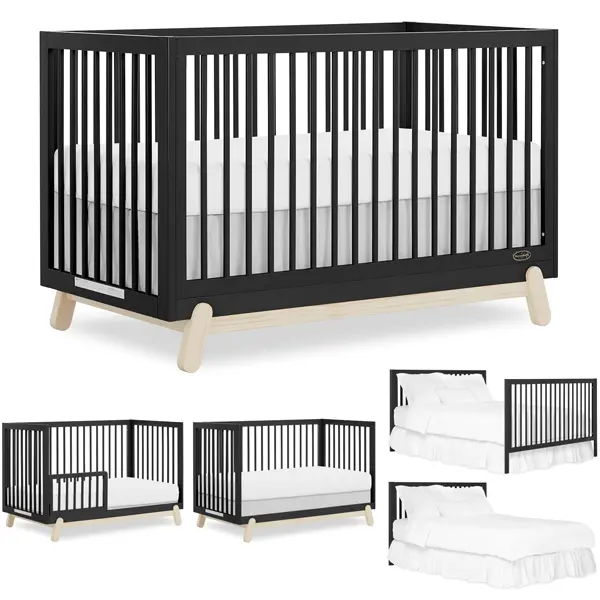
Dream On Me Hygee 5-in-1 convertible crib in Matte Black, shown as a crib, toddler bed, daybed, and full-size bed with or without a footboard.
Over the past year, we’ve also seen newer designs that push this even further — starting as a bassinet and eventually converting into a full adult bed. A good example is the Babyletto Rolli crib, which markets itself as a true grow-with-me sleep system from the newborn stage through childhood. That level of flexibility can make a crib a genuine long-term investment.
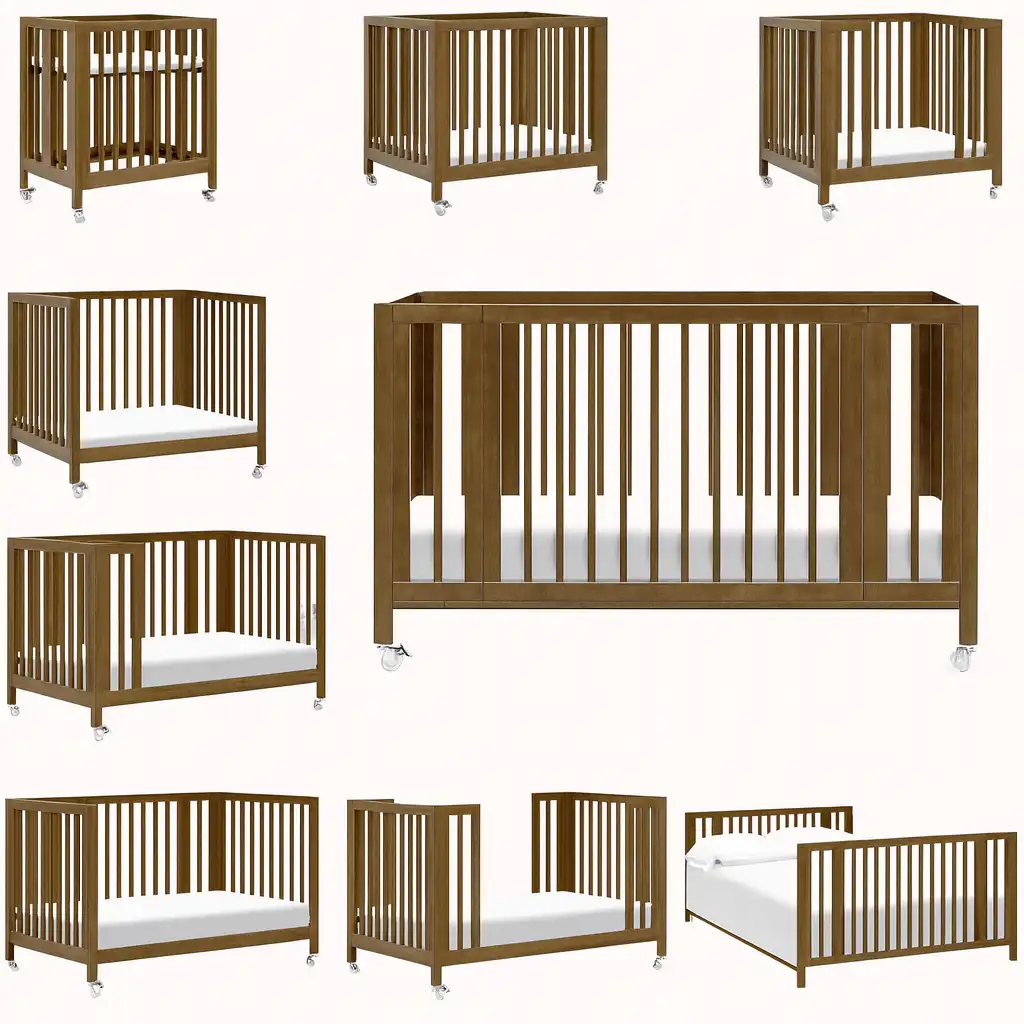
Babyletto Rolli crib shown in all its convertible stages, from bassinet, midi crib, midi toddler bed, midi daybed, standard crib, toddler bed, daybed, junior bed, and full-size bed.
Mini Crib Convertibility
Mini cribs typically convert into a daybed and sometimes into a twin bed (with or without a footboard). Most do not include a dedicated toddler bed stage.
For example, the Carter’s by DaVinci Colby mini crib doesn’t just convert into a toddler bed — it also converts into a twin-size bed. It even includes a built-in storage drawer underneath, which adds practical value in smaller spaces.
This is a good reminder that “mini” doesn’t always mean short-term. Some models are designed to function well beyond the early toddler years — you just need to check the individual conversion options carefully.
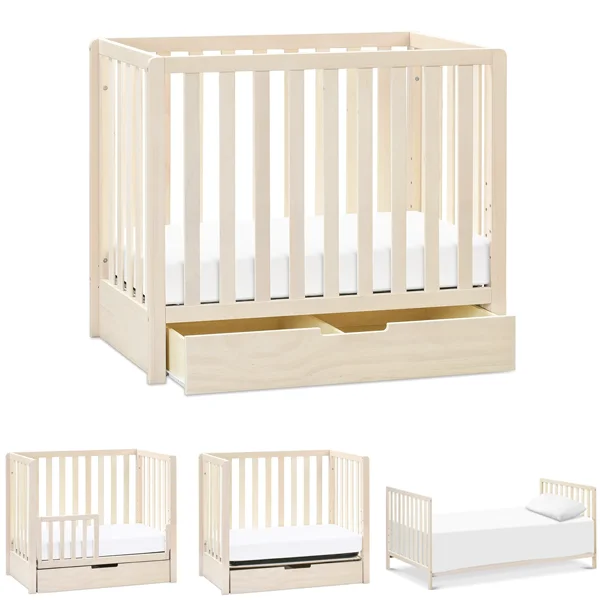
That said, even when a mini crib converts to a toddler bed, the sleep surface remains smaller than a toddler bed converted from a full-size crib. This is simply due to the original crib dimensions — the frame doesn’t suddenly become bigger.
💡 Note: One important thing to understand is that “convertible” doesn’t mean the same thing across brands. Some cribs include all conversion stages in the original purchase price, while others require separate kits. In some cases, a crib labeled “convertible” may only convert to a single additional stage.
For a full explanation of how these stages work, see What Is a Convertible Crib?
Portability: Where Mini Cribs Clearly Win
This is one area where mini cribs have a clear advantage. They’re easier to move, easier to store, and often designed with wheels or folding mechanisms.
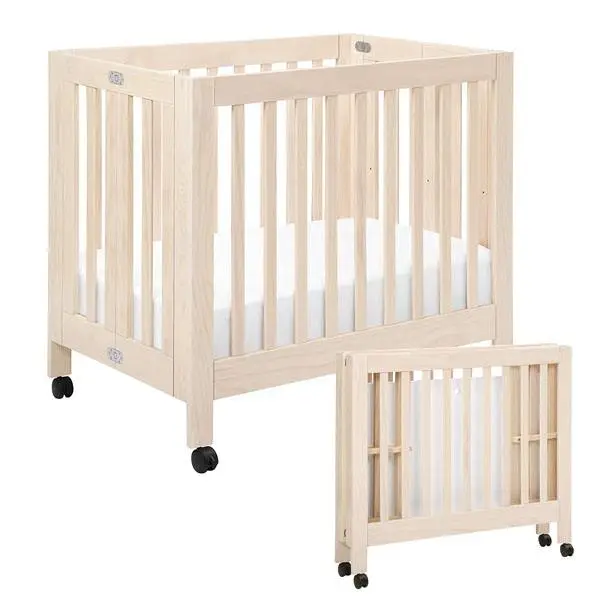
Babyletto Origami, mini portable, folding crib on wheels
They work great for:
- Room-sharing setups
- Small bedrooms
- Grandparents’ homes
- Shared sibling rooms
💡 Note: Some full-size cribs are also marketed as portable. For example, the Babyletto Maki even features a folding mechanism. However, standard cribs are still bulkier, even when folded. Their larger frames make them heavier and harder to move compared with mini cribs.
Are Mini Cribs as Safe as Standard Cribs?
Yes—as long as they meet current U.S. safety requirements.
Both mini and standard cribs sold in the U.S. must comply with current CPSC crib safety standards.
That means:
- Identical slat spacing rules
- Identical rail height requirements
- Similar structural strength testing
A mini crib is not less safe by design. Babies don’t climb out sooner because it’s a mini crib — they outgrow it sooner simply because it’s shorter.
Mini Crib vs. Standard Crib: Pros and Cons
Mini Crib Pros
- Takes up less space
- Easier to move, reposition, and store
- Lower upfront cost (but may require upgrading later)
- works well as a long-lasting bassinet alternative
- Ideal for apartments and room-sharing
Mini Crib Cons
- Baby outgrows it sooner
- Lighter build can feel less sturdy than full-size models
- Mattress and sheet sizing require closer attention
- May require upgrading to a larger bed earilier
Standard Crib Pros
- Longest usable lifespan in crib mode
- Heavier, sturdier construction
- Standardized mattress sizing
- Stronger long-term value
- Can serve as your child’s only bed through toddlerhood (if convertible)
Standard Crib Cons
- Requires more floor space
- Higher upfront cost
- Less portable and harder to move
Frequently Asked Questions: Mini Crib vs. Standard Crib
Cost Over Time: Which Crib Is the Better Investment?
When comparing mini and standard cribs, it’s easy to focus on the upfront price — but long-term costs matter just as much.
- Mini cribs are generally cheaper to buy initially, which makes them attractive for small spaces, room-sharing, or secondary cribs. However, most babies outgrow mini cribs within 12–24 months, so you may need to purchase a standard crib later, adding to the total cost.
- Standard cribs cost more upfront, but many are convertible and can last through toddlerhood and sometimes even into a full-size bed. Over several years, that one initial investment often ends up being more cost-effective, saving you the expense of an extra crib later.
Bottom Line
At the end of the day, this isn’t about which crib is “better” — it’s about which one fits your lifestyle.
If you’re working with limited space, plan to room-share for an extended period, or simply want something more substantial than a bassinet without committing to a full-size crib, a mini crib makes a lot of sense. For many families, it’s a practical, space-smart solution that comfortably covers the first 12–24 months.
But if you have the room and want one bed that truly lasts through the toddler years without upgrades or replacements, a standard crib is usually the better long-term investment. It offers more sleeping space, wider mattress availability, and fewer transitions down the road.
Neither option is wrong — it just depends on whether flexibility and space-saving matter more to you than long-term longevity.