
Last Updated on October 9, 2026
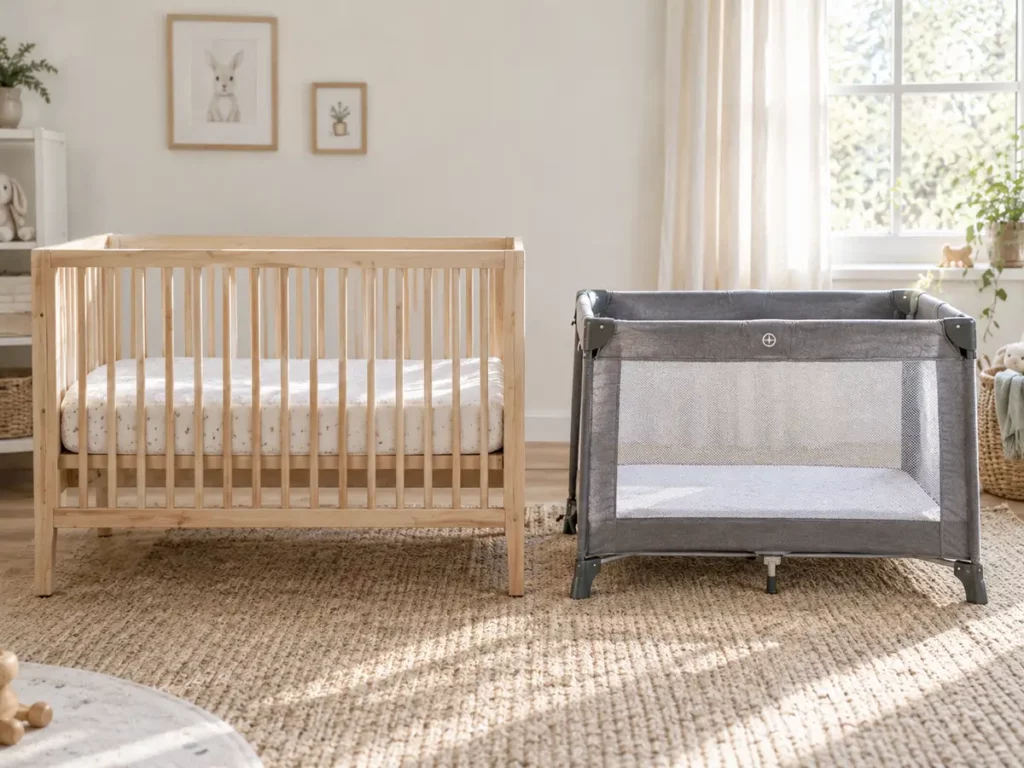
When I was choosing a sleep space for my first baby, I remember wondering whether a playard could actually replace a crib. Could a baby really sleep in a Pack ’n Play instead of having a traditional crib? And if it could, did I need both?
My first thought was simple: I wanted the safest option for my baby.
But safety alone doesn’t really settle the crib vs. Pack ’n Play question. Both can provide a safe sleep space when they are used as intended.
The bigger difference is what each product is designed to do.
A crib is usually a more permanent sleep space for the nursery. A Pack ’n Play is designed to be more flexible. It can provide a sleep space while also giving your baby a place to play, and it’s made to be moved, folded, stored, and taken along when you travel.
So instead of asking “Which one is safer?”, it may be more helpful to ask: “Which one fits the way you live?”
A quick note about the name: Pack ’n Play is Graco’s brand name for its portable playards. Over the years, though, many parents have started using “Pack ’n Play” as a general term for this type of product. In this article, I’ll use Pack ’n Play and playard interchangeably when referring to portable playards.
Crib vs. Pack ’n Play at a Glance
| Feature | Crib | Pack ’n Play |
| Primary use | Dedicated sleep space | Sleep, play, and portability |
| Portability | Usually limited | High |
| Folds for travel | Usually no | Most models fold, but it depends on the model |
| Sleep surface | Crib mattress made for that crib | Manufacturer-supplied playard sleep surface |
| Sleep-space size | Usually larger | Usually more compact |
| Mattress height | Usually adjustable | Depends on configuration; some models have a raised bassinet |
| Long-term use | Often designed for longer use, depending on model | Depends on the model and its limits |
| Sturdiness & stability | Rigid, heavier construction | Lightweight, folding construction |
| Storage | Some models have drawers or under-crib storage | Some models include organizers or small storage compartments |
| Bassinet option | Some newer models | Some models |
| Changing station | Some combo or convertible models | Some models include a changing station |
| Materials | Commonly wood; some are metal or acrylic | Lightweight frame with plastic/metal components and mesh or fabric |
| Appearance | More furniture-like | More functional and portable |
| Price | Wide range | Wide range, depending on model and features |
| BEST CRIBS | BEST PACK ‘N PLAYS |
What’s the Main Difference Between a Crib and a Pack ’n Play?
The easiest way to think about it is this: a crib is primarily a dedicated sleep space, while a Pack ’n Play is a portable playard that can also provide a sleep space.
A crib usually stays in the nursery and becomes part of the room. A Pack ’n Play can move from the bedroom to the living room, go to Grandma’s, or come along on a trip.
If you want a permanent nursery sleep space, a crib may be the better fit. If you want flexibility, a Pack ’n Play may make more sense.
And you don’t necessarily have to choose. Many families use a crib for everyday sleep and keep a Pack ’n Play for travel, another room, or visits with family.
Crib vs. Pack ’n Play: How They Compare
One of the easiest ways to compare a crib and a Pack ’n Play is to look at how each one fits into everyday life. Here are the differences that matter most when you’re choosing between them.
One of the first differences you’ll notice is size.
A standard full-size crib gives your baby a larger sleeping area than a typical Pack ’n Play. In the U.S., a full-size crib has an interior sleeping area of about 52⅜ by 28 inches, within the permitted tolerances.
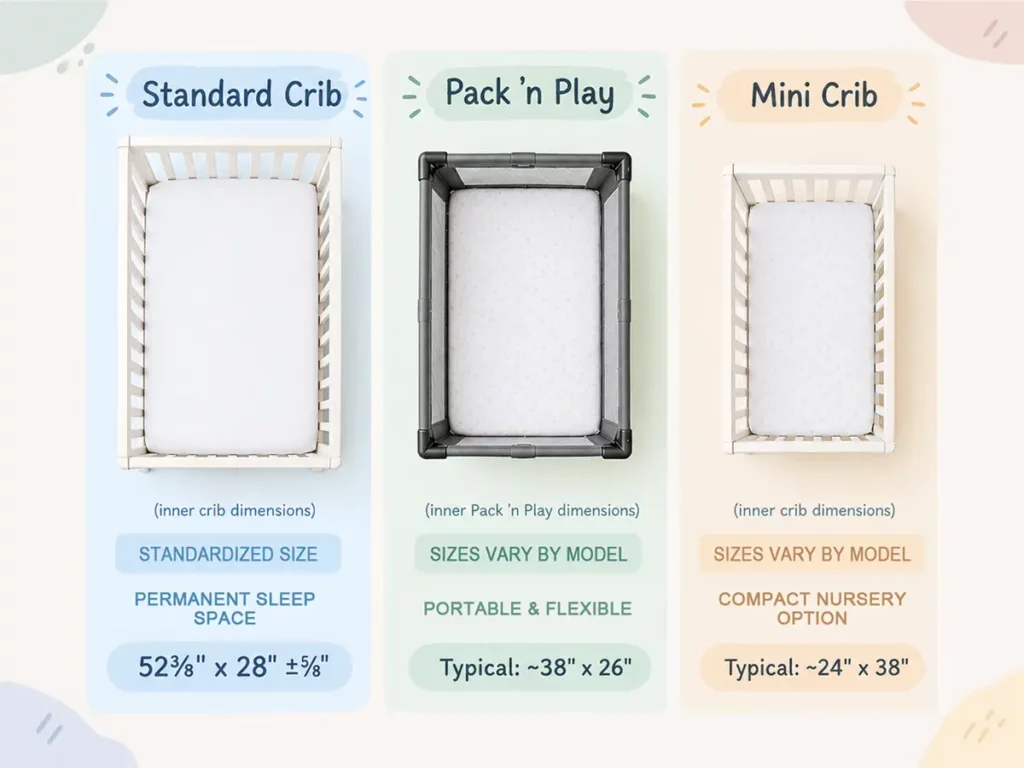
Pack ’n Plays don’t all have the same dimensions, so it’s worth checking the specifications for the particular model you’re considering. In general, though, their smaller footprint can be handy if you’re sharing a bedroom with your baby or simply don’t want a full-size crib taking up a permanent spot.
And then there are mini cribs.
Mini cribs are smaller than standard full-size cribs, but there isn’t one universal mini-crib size. Under U.S. regulations, smaller cribs fall into the broader category of non-full-size cribs, which covers a range of sizes and designs.
So if you’re comparing a mini crib with a Pack ’n Play, don’t look only at the outside dimensions. They’re still different types of products, with different construction, mattress systems, and intended uses.
This is where the Pack ’n Play really stands out.
Most Pack ’n Plays are designed to fold for storage and transportation. Many come with a carrying bag, too.
That makes them useful not just for moving between rooms, but also for travel, weekend trips, temporary sleeping arrangements, or visiting grandparents.
Some cribs are portable, too. Some full-size and many mini cribs stand on wheels. Some even fold for easier moving or storage.
But there’s an important distinction. A portable crib is still primarily a crib that you can move around your home more easily.
This is one area where you shouldn’t treat the two products as interchangeable.
A crib uses a mattress specifically designed to fit that crib. A standard full-size crib mattress is much more substantial than the sleep pad that comes with most playards. Under U.S. requirements, a full-size crib mattress can be up to 6 inches thick.
The sleep surface in a Pack ’n Play is different. It’s thinner because it is designed specifically around the playard’s frame, dimensions, and folding system. That can be surprising the first time you see one.
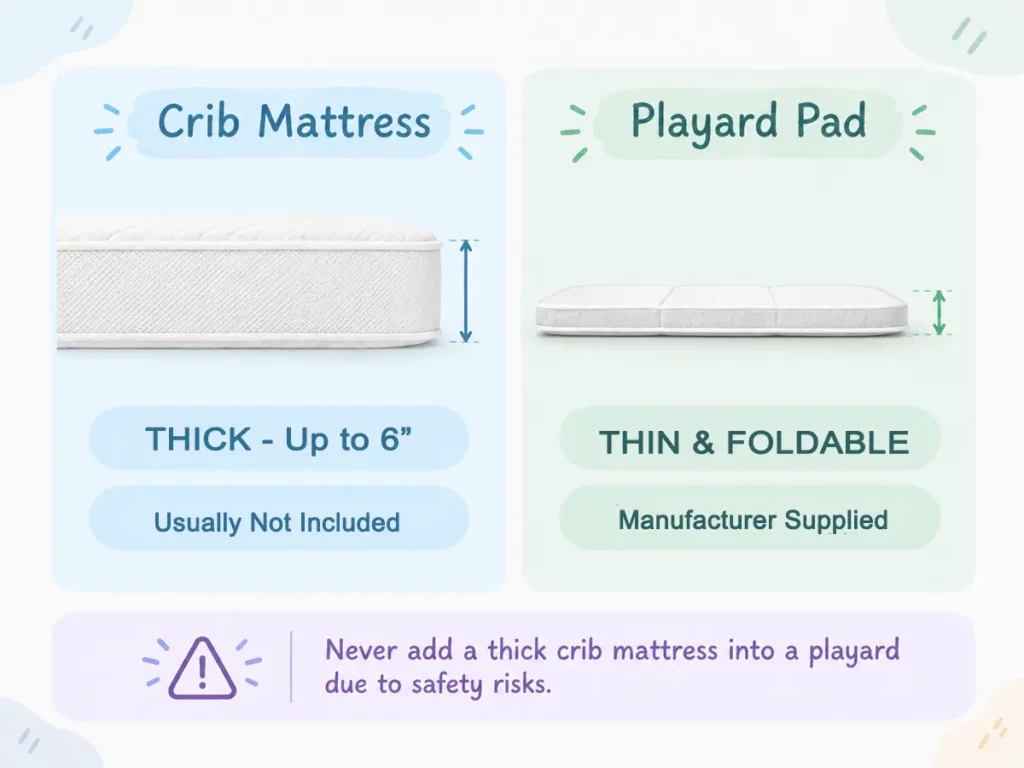
If you’re used to a thick crib mattress, you might look at the relatively thin playard pad and think, “Surely my baby needs something more substantial than this.”
That can lead some parents to wonder whether a mini crib mattress might work instead, since it can be similar in size. But you shouldn’t put a crib mattress inside a Pack ’n Play just because it seems to fit. Adding another mattress or extra padding can create gaps or other hazards.
Just because it’s thicker doesn’t mean it’s better or safer for your baby.
Another difference you notice quickly once you use these products every day is how far down you have to reach.
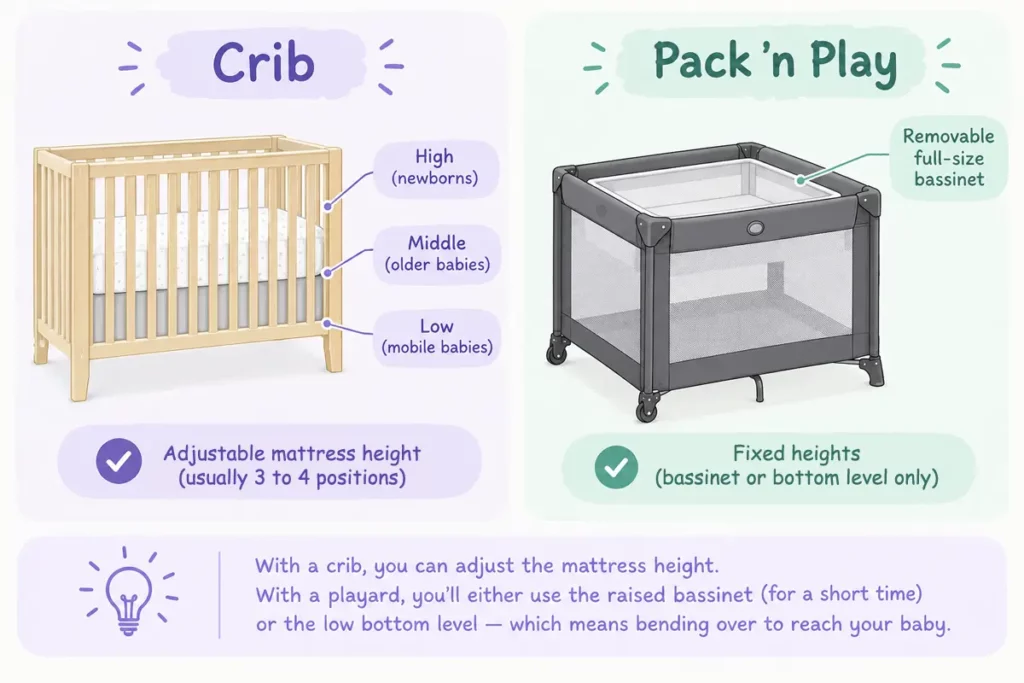
Most cribs have an adjustable mattress support. You can set the mattress higher when your baby is young, then gradually lower it as your baby grows and becomes more mobile. That can make those first months easier, especially when you’re lifting your newborn in and out of the crib several times a day.
Some playards have a raised bassinet, which is really handy for newborns. But it’s just for those first weeks. Once your baby starts pushing up or rolling over, you shouldn’t use it anymore. After that, you have to move your baby down to the bottom level, which is often even lower than the lowest crib mattress setting. So pretty soon, you’ll find yourself bending way over the side of the playard to your baby.
If you’ve ever tried to lower a sleeping baby onto a playard’s bottom surface, you know exactly what I mean.
It’s not a safety issue. It’s simply one of those everyday practical differences that can matter more than you expect when you’re using the sleep space over and over again.
Cribs and playards also feel very different because they’re built for different jobs.
Most traditional cribs are made from wood, although you’ll also find metal and acrylic designs. They have a rigid frame and are meant to stay assembled in one place.
A playard uses a lightweight folding frame with plastic and metal components and fabric or mesh sides. That construction lets it fold down and travel with you.
Cleaning is another small but real difference. A crib’s hard surfaces are usually easy to wipe down, while a Pack ’n Play has fabric and mesh that can catch milk, spit-up, or other messes. Some playard fabrics can be removed and washed, but cleaning depends on the particular model.
So, in everyday use, a crib generally feels more substantial and furniture-like, while a playard feels lighter and more flexible.
Price can go either way, because both cribs and Pack ’n Plays come in a wide range of models.
Still, you’re often paying for different things.
A crib can be a bigger nursery investment, especially if you choose a decorative or convertible model. Some convertible cribs transition from a crib to a toddler bed and, depending on the model, other bed configurations as your child grows.
A Pack ’n Play can be a practical way to get a portable sleep and play space without buying a full piece of nursery furniture. But how long you can use it depends on the model and its weight, height, developmental, and configuration limits.
Durability is different, too.
A well-made crib can stay assembled and in use for years. A Pack ’n Play is built with a different kind of durability in mind. It needs to handle repeated folding, transporting, storing, and setting up. So I wouldn’t look at durability as simply “Which one lasts longer?”
Once you start looking at actual models, you’ll notice that both categories can come with plenty of extras. These features can be convenient, especially if you’re trying to make the most of a small room.
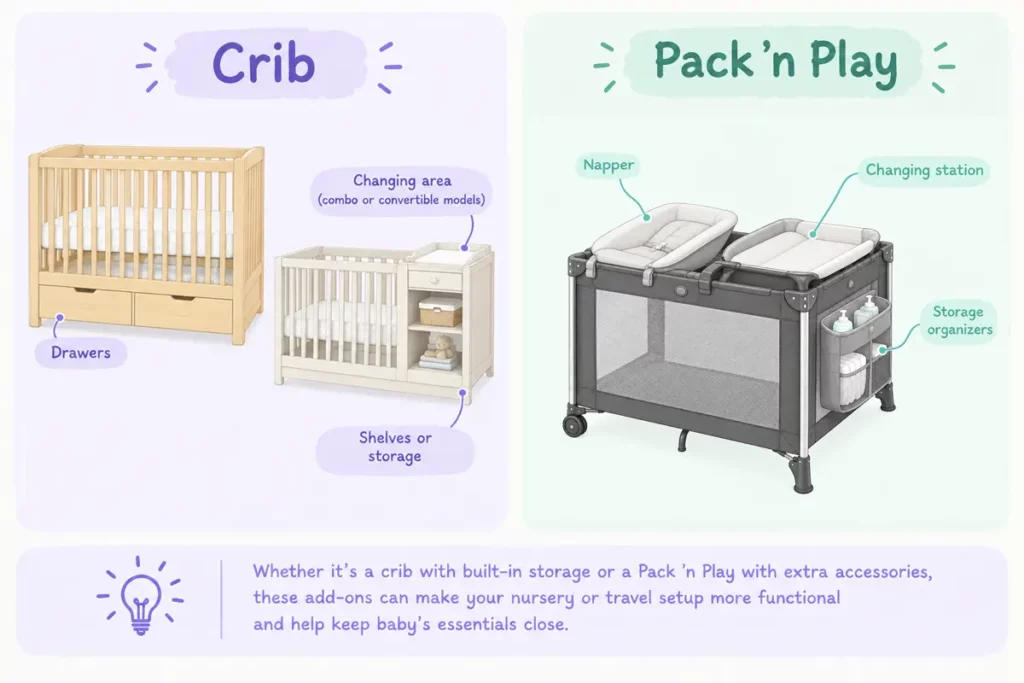
Some cribs are available as nursery furniture with drawers, shelves, or storage underneath. Certain combo or convertible models may also include a changing area.
Pack ’n Plays can come with their own collection of accessories. Depending on the model, you may find a raised bassinet, a changing station, a napper, or small storage organizers.
What About Safe Sleep?
The same basic safe-sleep principles apply to both cribs and Pack ’n Plays. The important thing is to use a sleep product as intended, use the sleep surface that comes with it, and follow the manufacturer’s instructions and limits.
For a closer look at the basics, see our guide to safe sleep for babies.
So, Should You Buy a Crib or a Pack ’n Play?
There’s no single right answer. It depends on what you want the product to do.
A crib may be the better fit if you want:
A Pack ’n Play may be the better fit if you want:
And remember, you don’t have to choose one or the other. A crib can be your baby’s main sleep space at home, while a Pack ’n Play can handle travel, grandparents’ houses, or those moments when you want a sleep space in another part of the house.
Thanks for all the research about baby beds, however please do more research into SIDS. Your link is not accurate at all. SIDS is not unexplained death! It is absolutely explained!
A defect in the baby’s brain is NOT the cause of SIDS; the heavy metals and other toxic ingredients which are barbarically injected into babies during their precious first year of life, cause inflammation in the developing brain! This extreme inflammation leads to death. Death often occurs in a crib because babies spend a lot of time in their crib during their first year of life.
I have researched SIDS, and the given links are relevant! A sudden infant death syndrome (SIDS) is, unfortunately, unexplained death in the crib!
I assume that by “barbarically injected heavy metals and other toxic ingredients” you mean routine immunizations?
Studies to date have shown that some factors might put babies at extra risk, however, vaccination is NOT one of them! There’s no evidence that vaccination increase SIDS risk! On the contrary, there is some evidence that indicates immunization can help prevent SIDS.
The most recognizable factor linked to SIDS is an improper sleeping environment! You can significantly reduce the risk for SIDS by following safe sleep recommendations, and that is it.
So please do not use our site to promote “anti-vax” myths, conspiracy theories, and misinformation! Especially in these sensitive times!
Vaccines are the world’s safest method to protect us from life-threatening diseases. They have safely reduced diseases like polio, measles, and smallpox, so you don’t have to deal with them today. Furthermore, vaccination saves more than five lives every minute – preventing up to three million deaths a year, even before the arrival of COVID-19.
Regards, BLP!