
Last Updated on September 30, 2026
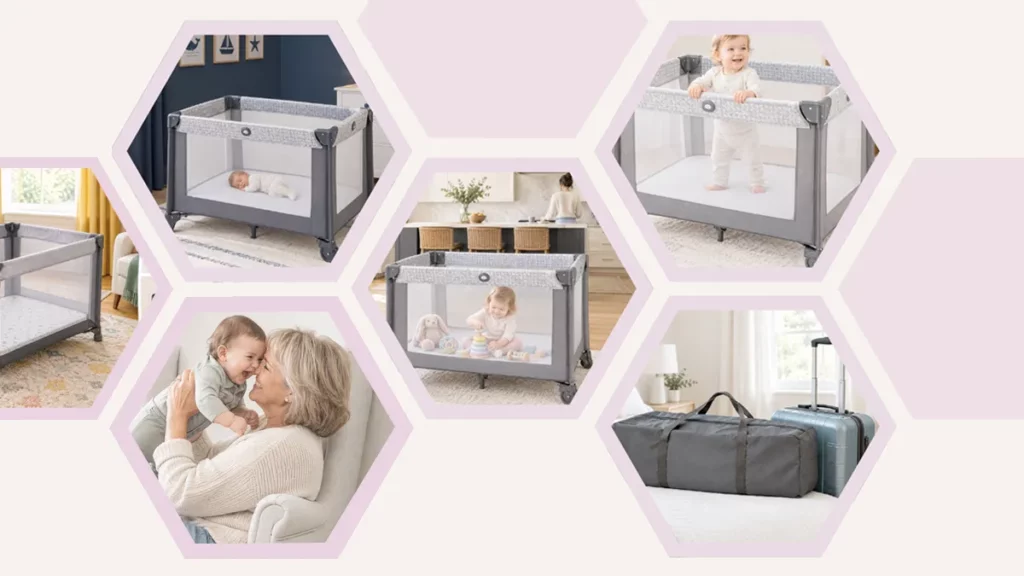
Wondering what is a Pack ’n Play? A Pack ’n Play is basically a portable playard—a safe spot where your baby or toddler can sleep or play. Since it folds up easily, you can use it around the house, on trips, or leave one at the grandparents’ house.
Pack ’n Play is actually the Graco brand name, but you’ll often see the term used more broadly for portable playards from other brands, too.
So, what can you actually use one for—and does your family need one?
What Is a Pack ’n Play?
A Pack ’n Play, also called a playard or play yard, is a framed enclosure with a floor and mesh or fabric sides. Unlike a traditional crib, it is designed to fold for storage and transport.
The CPSC defines a play yard as a framed enclosure with a floor and mesh or fabric sides that provides sleeping and playing accommodation. Play yards are designed for use at home, while traveling, and in other settings.
Most traditional playards have:
- A folding frame
- Mesh sides
- A padded floor or sleep pad designed for that specific product
- A carrying bag
- A relatively compact folded size
Some models also include features such as a full-size bassinet, changing station, storage organizer, or other accessories.
What Is a Pack ’n Play Used For?
A Pack ’n Play is useful because the same basic product can serve several purposes as your child grows.
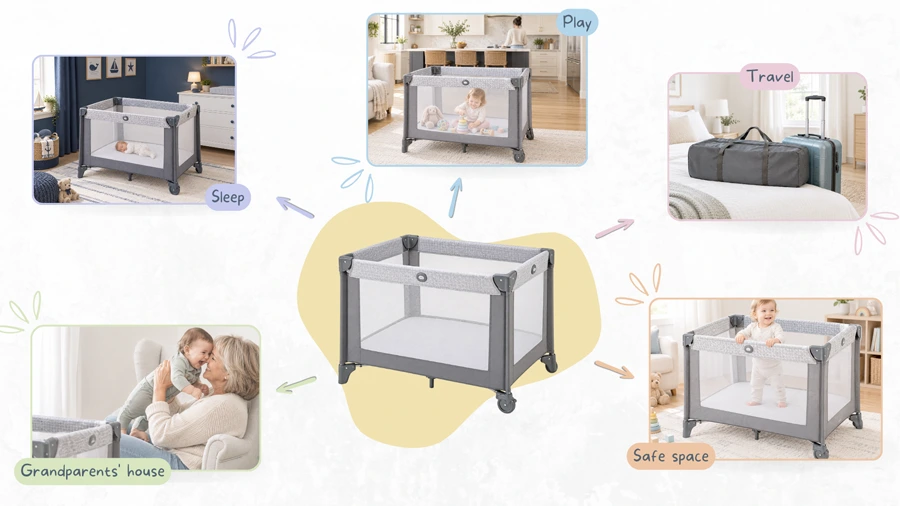
1. Pack ’n Play Is Used for Sleeping
A Pack ’n Play can provide a safe sleep space for naps or overnight sleep when it is used according to the manufacturer’s instructions.
The CPSC recognizes play yards as products that can provide sleeping accommodation, and the AAP lists portable play yards among safe sleep options when used properly with a firm, flat mattress and a fitted sheet.
You don’t need to go into all the safe-sleep details here. For those, see our guide to Is a Pack ’n Play Safe for Your Baby.
2. Pack ’n Play Is Used for Travel
Travel is one of the biggest reasons families choose a Pack ’n Play.
Instead of relying on a crib at a hotel, vacation rental, or relative’s house, you can bring a familiar sleep space with you. A playard can also be useful for road trips because it folds into a carrying bag and can be stored with the rest of your luggage.
Not all playards are equally portable, though. A traditional full-size model can be fairly bulky, especially if it includes several accessories. A lightweight travel crib may be easier to manage if you frequently fly or need to carry the sleep space long distances.
3. Pack ’n Play Provides a Temporary, Contained Space
A Pack ’n Play can give your baby a defined space to stay while you’re nearby but need your hands free.
For example, you might use it in the living room while preparing dinner, in another room while doing a quick household task, or when visiting someone else’s home.
It isn’t a replacement for supervision, but it can be useful when you want your baby to have a contained space rather than moving freely around an unfamiliar room.
4. Pack ’n Play Can Be Used for Playtime
Once your child is developmentally ready to use the playard as a play space, it can also be used for supervised play.
A playard gives babies and young toddlers a defined area for toys and floor play without requiring you to babyproof an entire room.
Some models also have a zippered side door that allows an older baby or toddler to enter and exit the playard when the feature is designed for that use.
5. Pack ’n Play Can Be a Second Sleep Space
You don’t necessarily have to use a Pack ’n Play as your baby’s main sleep space.
Many families keep a crib in the nursery and use a playard as a second sleep space in another part of the house. It can be especially convenient for downstairs naps or for families who spend a lot of time at a grandparent’s or caregiver’s home.
If your baby regularly stays with a grandparent or another caregiver, keeping a playard there can also save you from transporting one back and forth. When my children were little, I actually bought two Graco Portable Pack ’n Play Playards—one for our home and one for their grandparents’ house. At around $50 each, they were inexpensive enough that having two made more sense than constantly packing one up and taking it back and forth. We used ours quite a bit in the kitchen and living room while I was cooking or doing things around the house, and having the same playard at their grandparents’ house meant the kids always had a familiar place to sleep and play when we visited.
Types of Pack ’n Plays and Playards
Not every Pack ’n Play is built the same way. In general, they fall into three broad groups that differ mainly in their features, weight, and portability. These differences can affect how and where you’re likely to use the playard.
Traditional or Full-Size Playard
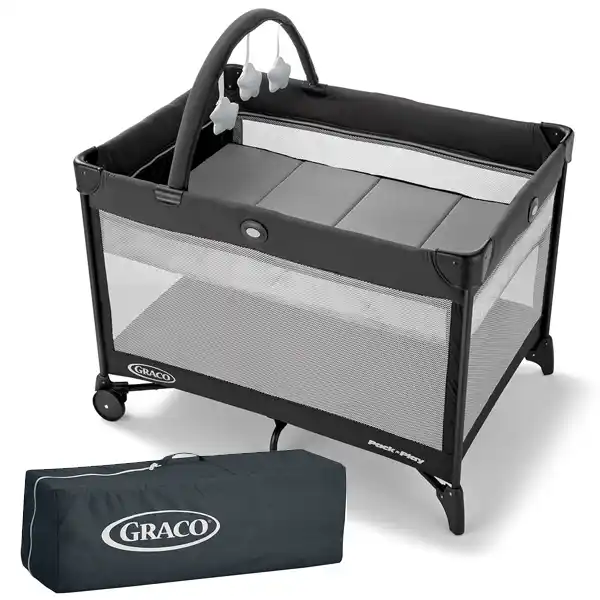
A traditional playard is the basic version: a sturdy folding frame, mesh sides, a sleep surface supported above the bottom of the frame, and a carrying bag. Many traditional playards also include a full-size hanging bassinet that attaches to the upper rails and creates a raised sleep space for newborns.
This type makes sense if you want one versatile product for naps, sleep, and play. Because it has fewer accessories than feature-heavy models, a traditional playard is also relatively straightforward to fold, store, move around, and take with you when traveling.
Playards With Bassinet or Care-Station Features
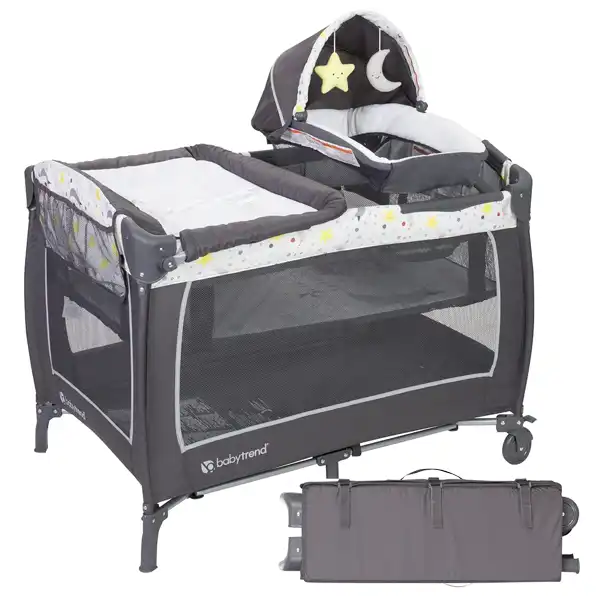
Some playards come with additional newborn and nursery features beyond the basic playard setup. Depending on the model, these can include a full-size bassinet, a clip-on napper or infant seat, a changing station, or a storage organizer. Some bassinet or napper attachments can also be used separately from the playard, depending on the manufacturer’s design.
These models can be convenient if you want one piece of baby gear to handle several jobs during the early months.
The tradeoff is that feature-heavy playards generally have more parts and can be heavier and bulkier than simpler models. However, most of the accessories can be removed before folding, so you can usually pack the playard itself into its carrying bag without taking all the extra pieces with you.
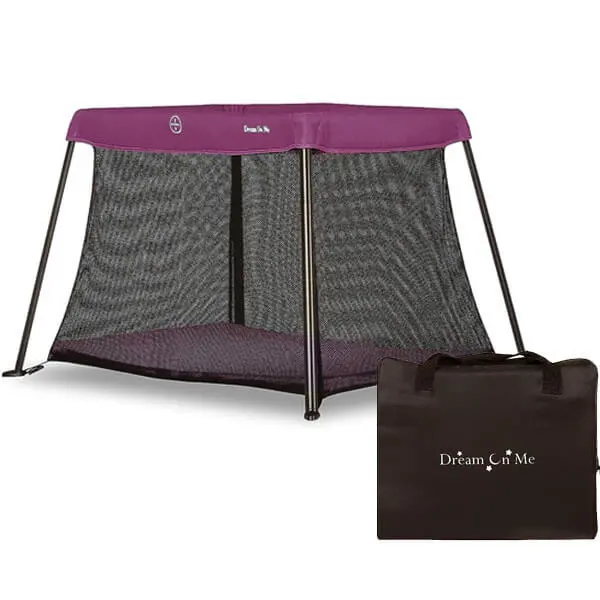
Lightweight Travel Cribs and Playards
Lightweight travel cribs are designed with portability as the priority. They typically have a lighter frame and a smaller packed size than traditional or feature-heavy playards. Some are even designed to be carried like a backpack or small piece of luggage.
Their construction is also a bit different. Many have a narrower upper frame and a wider footprint at the base, which helps create a stable structure while keeping the overall frame lightweight. The sleep surface is typically positioned directly on the floor as well, helping keep the center of gravity low and the structure stable.
This makes lightweight travel cribs particularly useful for families who travel frequently or have limited storage space. They can also work well as a portable sleep or play space at home, at a grandparent’s house, or when visiting friends and family.
A lightweight travel crib isn’t simply a smaller version of a Pack ’n Play. It’s a different style of portable baby sleep and play space, with portability and compact storage as major priorities.
Pack ’n Play vs. a Traditional Crib
A Pack ’n Play and a traditional crib can both be used as baby sleep spaces, but they are designed around different priorities.
| Pack ’n Play | Traditional Crib |
|---|---|
| Folds for storage and travel | Designed to remain assembled |
| Lightweight compared with most furniture-style cribs | Heavier and more permanent |
| Mesh or fabric sides | Rigid sides |
| Easy to move between rooms | Usually stays in the nursery |
| Useful for travel, sleep, and play | Primarily a nursery sleep space |
For a more detailed comparison, see our Crib vs. Pack ’N Play guide.
A Pack ’n Play can replace a crib for some families, but it doesn’t have to. For many parents, the two serve different purposes: the crib is the main nursery sleep space, while the playard provides flexibility.
Who Is a Pack ’n Play Useful For?
A Pack ’n Play can be particularly useful if you:
- Travel with your baby
- Visit grandparents or other caregivers regularly
- Want a second sleep space
- Need a portable option for different rooms
- Want one product that can serve both sleep and play purposes
- Live in a smaller home and don’t want another full-size piece of furniture
It’s also useful for families who simply like having a portable baby space available when they need it.
Who Might Not Need a Pack ’n Play?
A Pack ’n Play isn’t essential baby gear for every family.
You may not need one if you:
- Rarely travel
- Already have a crib and don’t need a second sleep space
- Don’t regularly visit homes where you need portable baby gear
- Have limited storage and don’t expect to use a playard often
If your baby has a crib at home and you don’t need a portable sleep or play space, a Pack ’n Play may be a convenience rather than a necessity.
That’s really the main question to ask: Would a portable sleep and play space make your everyday life or travel easier?
A Few Common Pack ’n Play Questions
The Bottom Line
A Pack ’n Play is essentially a portable sleep and play space. It can be useful at home, on vacation, at a grandparent’s house, or anywhere you need a familiar place for your baby to sleep or play.
Which kind you pick really comes down to what your family needs most:
- A traditional playard is simple and practical. It is great if you want something reliable for both home use and occasional trips.
- A care-station playard is useful if you want extras like a bassinet or changing table.
- For families who are always on the go, a lightweight travel crib is designed with portability in mind. It’s easy to grab and take anywhere.
And do you actually need one? Not necessarily. If you already have a crib and rarely travel, you may be perfectly happy without one. But if you want a portable second sleep space, a travel crib, or a contained place for play, a Pack ’n Play can earn its spot in your baby gear.
If you’re trying to choose between these options, see our guides to the best Pack ’n Plays and the best lightweight travel cribs.