
Last Updated on September 18, 2026
Editor’s Note: This article was originally published in May 2024 and was completely rewritten on September 16, 2026, to align with the latest CPSC safety regulations and updated infant sleep guidelines.
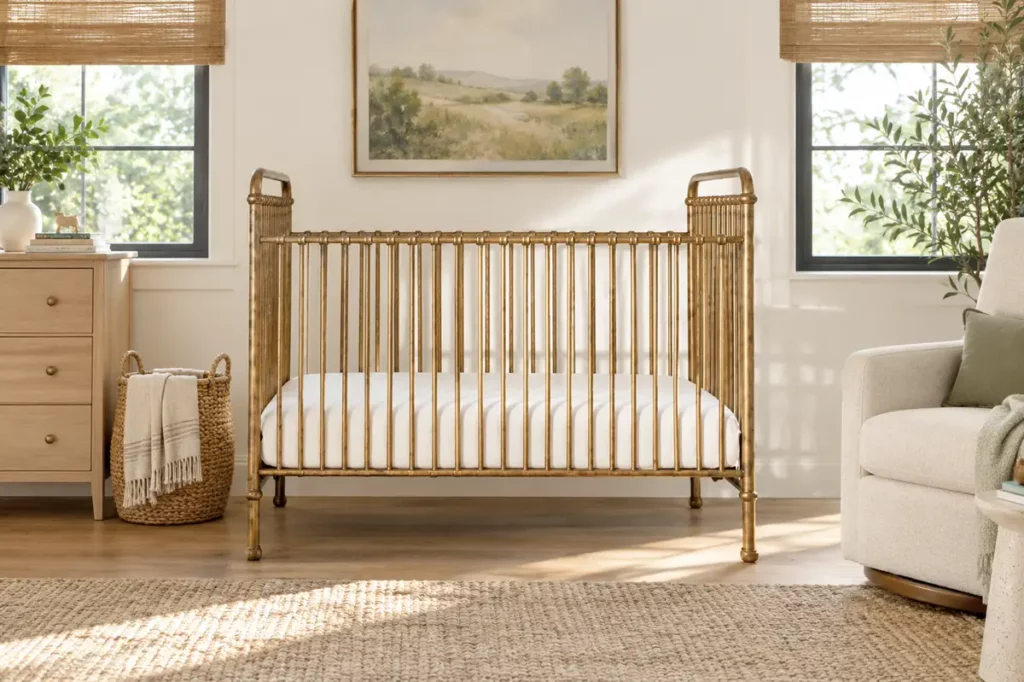
Metal cribs can bring a completely different look to a nursery. From vintage-inspired iron designs to sleek modern frames, they’re durable-looking, easy to wipe clean, and often chosen by parents who want something a little different from a traditional wooden crib.
But are metal cribs safe for babies?
Yes. A metal crib can be a safe choice for a baby when it is properly designed, meets current U.S. crib safety requirements, is correctly assembled, and remains in good condition. The fact that a crib is made from metal rather than wood does not, by itself, make it unsafe.
What matters more is how the crib is constructed and finished. With a metal crib, that means paying particular attention to the frame, welded or joined sections, slat spacing, hardware, surface finish, mattress support, and overall stability.
Here’s what I would look at before putting a baby in one.
- Are Metal Cribs Safe?
- What Makes a Metal Crib Safe?
- What About the Mattress in a Metal Crib?
- Are Metal Cribs Safer Than Wooden Cribs?
- My Favorite Metal Crib
- Potential Advantages of Metal Cribs
- Things to Consider With Metal Cribs
- What About Older Metal Cribs?
- How to Check a Metal Crib Before Your Baby Uses It
- Are Metal Cribs Safe for Babies? The Bottom Line
Are Metal Cribs Safe?
Yes. Metal itself isn’t the safety concern.
In the U.S., full-size baby cribs must meet federal safety requirements, whether they are made primarily of metal, wood, or other materials. The U.S. Consumer Product Safety Commission (CPSC) regulates full-size cribs under 16 CFR Part 1219, which incorporates the applicable ASTM safety standard.
These safety requirements cover things like the crib’s strength and stability, slat spacing, mattress support, hardware, openings, sharp edges, and other potential hazards.
Metal itself is therefore not dangerous; what matters more is whether the particular metal crib is well made, properly assembled, in good condition, and compliant with current safety standards.
That’s where the real safety differences come in.
What About Metal Mini Cribs?
If you’re looking at a metal mini crib, it falls under the federal safety requirements for non-full-size cribs, which are covered separately by CPSC requirements for non-full-size baby cribs.
These safety requirements cover many of the same basic concerns as those for full-size cribs. The main difference for parents is that mini crib interior and mattress dimensions of mini cribs are not standardized. That means you need to pay closer attention to the mattress size specified by the crib manufacturer.
So, just as with a full-size crib, the fact that a mini crib is made of metal does not make it inherently less safe.
What Makes a Metal Crib Safe?
A good metal crib shouldn’t simply look sturdy. Its construction needs to withstand normal use while avoiding openings, projections, or hardware that could create an entrapment, fall, strangulation, choking, or injury hazard.
So, beyond meeting the safety requirements discussed above, what should you actually look for when inspecting a metal crib?
1. Check the space between the slats
This is one of the easiest things for a parent to understand — and one of the most important.
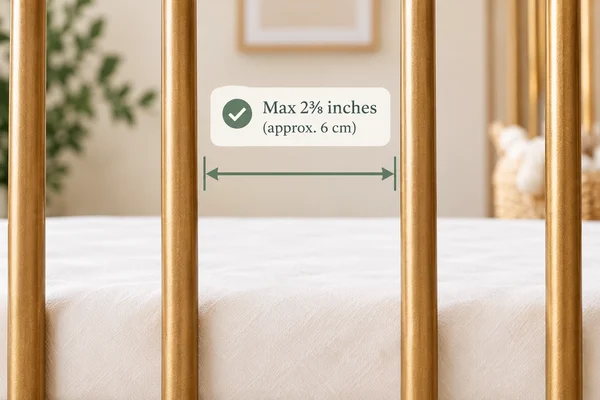
CPSC crib safety guidance says there should be no more than 2⅜ inches (about 6 cm) between crib slats. The purpose is to prevent a baby’s body from passing through the openings and becoming trapped.
2. Pay attention to welded joints and connections
This is one area where a metal crib deserves a little extra inspection.
The fact that a crib is welded does not automatically make it safer or less safe. What matters is the finished construction.
Look closely at the places where metal sections meet:
- Are the joints intact?
- Is anything visibly cracked or separating?
- Are there sharp projections?
- Does a joint move independently when it shouldn’t?
- Are there exposed pieces of hardware?
- Does the frame feel solid when gently pushed?
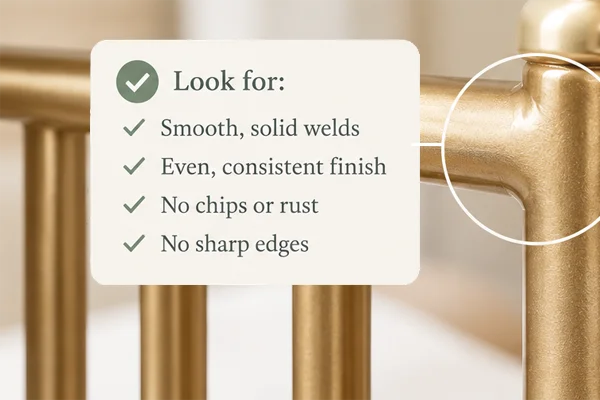
A decorative weld doesn’t need to look perfectly smooth to the naked eye, but there shouldn’t be an obvious sharp projection, broken section, or structural damage accessible to the child.
3. Look closely at the finish
A metal crib usually has a painted, powder-coated, enamel, or otherwise finished surface. That finish is part of what the baby can potentially touch, so it shouldn’t be treated as purely decorative.
Run your eyes — and, where appropriate, your hand — over accessible surfaces.
Look for:
- Peeling or flaking finish
- Exposed sharp metal
- Rust or corrosion
- Rough damaged areas
- Loose decorative pieces
- Chipped areas around joints or hardware
A small cosmetic mark isn’t necessarily a safety problem. But a damaged surface that exposes sharp metal or creates loose pieces deserves attention.
4. Make sure the crib is stable after assembly
Metal can give a crib a substantial, sturdy feel, but appearance isn’t a substitute for a properly assembled frame.
After assembly, check that:
- All required hardware is installed
- Screws and fasteners are properly tightened
- The mattress support is securely attached
- The frame doesn’t have an unusual wobble
- Joints don’t shift independently
- No component is visibly bent or damaged
CPSC specifically warns that missing, loose, broken, or improperly installed hardware can create dangerous gaps and entrapment hazards.
That’s why following the manufacturer’s assembly instructions matters. A crib that is safe when correctly assembled can become unsafe when parts are installed incorrectly.
A useful reminder that correct assembly is part of crib safety, not an afterthought, is the CPSC recall involving Cosco metal cribs. It shows how important it is to assemble a crib correctly. The cribs could be assembled with the mattress platform mistakenly used as a side rail, which made gaps of about 5 inches—much wider than allowed. This large spacing could trap a baby and cause serious harm or even death.
What About the Mattress in a Metal Crib?
The mattress matters just as much as the frame. Use a firm, tight-fitting crib mattress.
Full-size cribs and full-size crib mattresses are standardized in the U.S., so a properly made full-size crib mattress should fit a standard full-size crib without needing to be matched to a specific brand or model.
Mini cribs are different. Their mattress sizes can vary, so always follow the mattress size specified by the crib manufacturer.
You can read more in our guide to the best baby crib mattresses or learn more about why babies need a firm crib mattress.
Are Metal Cribs Safer Than Wooden Cribs?
There’s no reason to assume that a metal crib is inherently safer than a wooden crib — or vice versa.
The material alone doesn’t determine whether a crib is safe. As mentioned above, important questions are whether the specific crib complies with current safety requirements, has sound construction, fits its intended mattress correctly, and is used and maintained as directed.
The material can, however, change what you should pay attention to during inspection. With a metal crib, pay particular attention to welded or joined sections, rust, corrosion, sharp projections, and decorative openings or scrollwork. With a wooden crib, you might be more concerned about splinters, cracks, damaged wood, or loose wooden components.
In either case, construction and condition matter more than the material name on the product listing.
My Favorite Metal Crib
If you like the look of a traditional metal crib, the Namesake Abigail 3-in-1 Convertible Crib is one model worth considering.
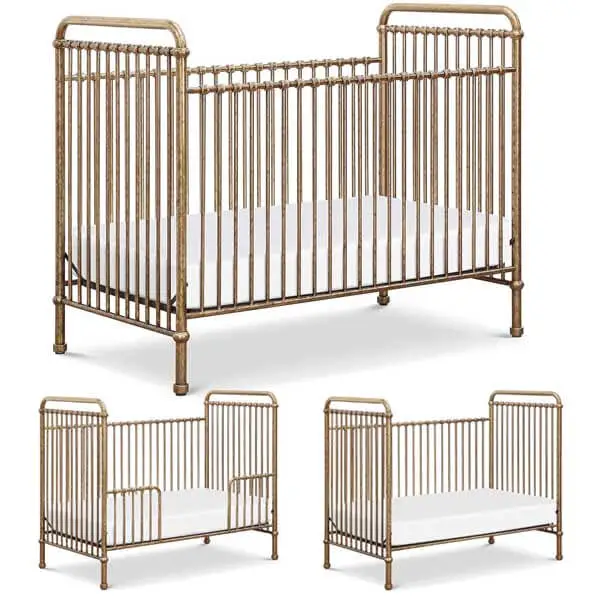
What stands out about the Abigail is its classic metal construction. It uses a steel frame with traditional metal casting at the joints and a powder-coated finish, giving it the vintage iron-crib look.
It has four adjustable mattress positions, converts from a crib to a toddler bed and daybed, and has all the current safety documentation you’d expect from a new U.S.-market crib.
And if you’re looking for a smaller option, there’s also the Namesake Abigail 3-in-1 Convertible Mini Crib, which has the same traditional metal look in a more compact size.
Potential Advantages of Metal Cribs
A well-constructed metal frame can feel substantial and may hold up well to everyday use. This can be appealing if you plan to use the crib for several years or through more than one child.
Many metal crib finishes are relatively easy to wipe down, which can be convenient during the inevitable spills and messes that come with a nursery.
Metal cribs come in a range of styles, from simple modern frames to vintage-inspired designs with brass-colored or antique-style finishes.
For a modern, industrial, vintage, or eclectic nursery, metal can offer an alternative to traditional wooden furniture.
Things to Consider With Metal Cribs
Ornamental scrollwork, unusual cutouts, and decorative extensions can make a crib visually interesting, but check that they don’t create accessible sharp projections, hazardous openings, or places where clothing could catch.
A chip in the finish isn’t automatically dangerous, but peeling or damaged coating shouldn’t be ignored—especially if it exposes sharp metal or creates loose pieces.
A metal frame may transmit sound differently from a wooden crib. Depending on the construction, some parents may notice more noise when the crib is moved or bumped.
Metal can feel cooler than wood when you touch it, even when both are at the same room temperature. That’s because metal conducts heat away from your skin more quickly. This is mainly a difference in how the materials feel, not a crib safety issue.
What About Older Metal Cribs?
This is where I’d be much more cautious.
Age matters more than the fact that the crib is metal. Older cribs may have outdated designs, missing parts, damaged finishes, or hardware that has loosened over time. If you’re buying a used crib, these issues are worth checking carefully before using it.
If you’re considering a secondhand metal crib, identify the exact brand, model, and manufacture date where possible. Check the CPSC recall database, make sure every original component is present, and follow the manufacturer’s assembly instructions.
Don’t assume that a crib is safe to use simply because it came from a reputable brand. If you can’t establish what the crib is, whether it was recalled, or whether you can obtain the correct replacement parts, I would not use it for a baby.
How to Check a Metal Crib Before Your Baby Uses It
Once the crib is assembled, do one final check before your baby sleeps in it. This is a condensed version of the main safety points covered above — something you can quickly work through and save for later reference.
You don’t need to be a crib inspector. You’re simply looking for anything that seems damaged, loose, incomplete, or different from the manufacturer’s instructions.
Metal crib safety checklist:
- All required parts and hardware are present.
- The crib has been assembled according to the manufacturer’s instructions.
- Nothing is visibly cracked, bent, broken, loose, or separating.
- The crib feels stable when gently pushed.
- Slat spacing is no more than 2⅜ inches.
- No slats are missing, loose, damaged, or bent.
- There are no accessible sharp projections or rough areas.
- There is no significant rust or corrosion.
- The finish isn’t peeling or flaking.
- No damaged area exposes sharp metal or creates a loose piece.
- The mattress fits snugly with no dangerous gaps.
- The mattress is firm and flat.
- The sleep space contains only a fitted crib sheet for routine infant sleep.
If anything looks damaged, doesn’t fit correctly, or leaves you unsure whether the crib is assembled or functioning as intended, stop and check the manufacturer’s instructions before using it.
Are Metal Cribs Safe for Babies? The Bottom Line
Yes — a metal crib can be a safe choice for your baby.
The important thing isn’t whether the crib is made of metal or wood, but whether the specific crib is properly designed, meets current U.S. safety requirements, is correctly assembled, and remains in good condition.
So if you like the look of a metal crib, there’s no safety reason to rule it out simply because of its material. Just evaluate the crib as you would any other baby sleep product — by its construction, compliance, condition, and how it is used.