
Last Updated on October 8, 2026
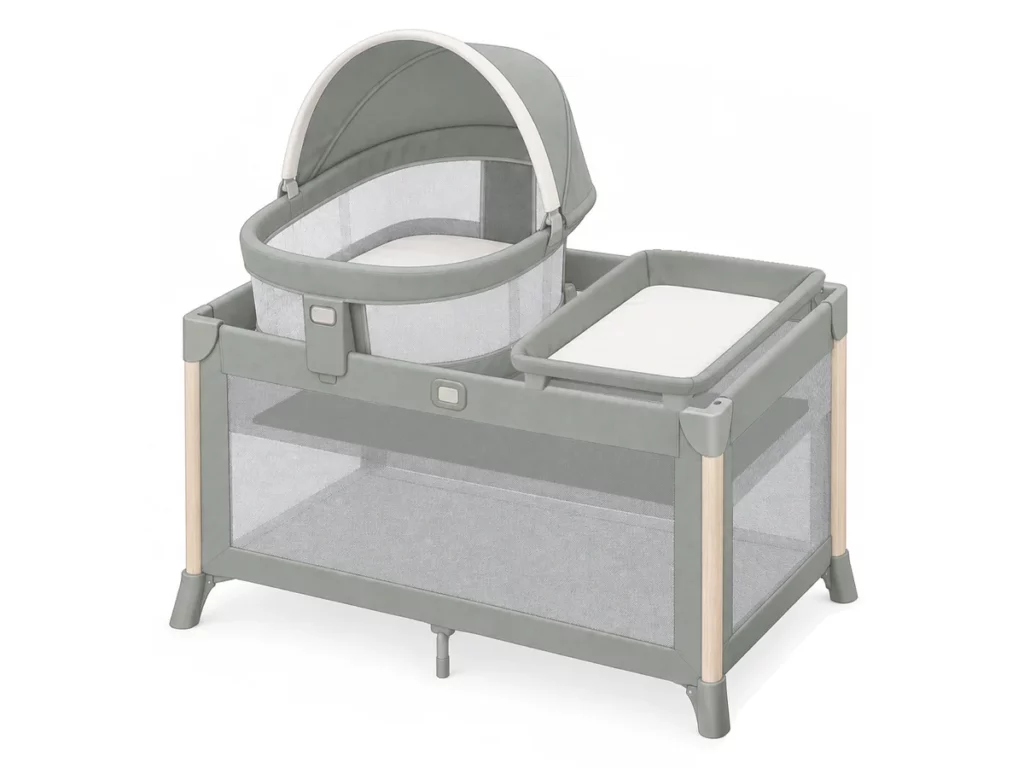
It depends on which type of bassinet you mean.
If you’re talking about the full-size bassinet insert that sits inside the Pack ’n Play, yes — it is designed to provide a raised sleep surface for a young baby.
The situation is a little different with smaller bassinets and other accessories that clip onto the top of a playard. Some are designed for infant sleep, while others are intended for supervised rest, play, or other purposes.
A napper, lounger, changer, or similar accessory is therefore not automatically a safe sleep surface simply because it attaches to a Pack ’n Play.
Editorial note: Pack ’n Play is Graco’s brand name for its portable playards, but the term is also commonly used to refer to this type of product in general. In this article, I use Pack ’n Play and playard interchangeably when referring to portable playards.
What Is a Pack ’n Play Bassinet?
Pack ’n Play bassinets generally fall into two categories:
- Full-size bassinet insert: A raised insert that sits inside the playard and covers the main sleeping area. It creates a higher sleep surface for a young baby while still using the playard’s frame and sides.
- Raised or portable bassinet: A smaller bassinet that attaches above part of the playard. Depending on the model, it may also be removable and usable separately from the playard.
These two types can look quite different, and their weight, age, and developmental limits can be different too.
Is Every Pack ’n Play Attachment Safe for Sleep?
No. A Pack ’n Play can include several different accessories, and they are not all designed for the same purpose.
1. Full-Size Pack ’n Play Bassinet
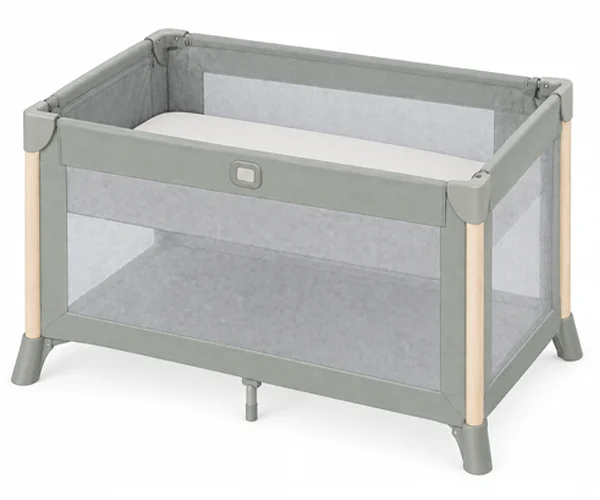
When a full-size bassinet is supplied as part of a Pack ’n Play, it is designed to be used with that playard as a raised infant sleep surface. The U.S. Consumer Product Safety Commission (CPSC) has specific requirements for play yards with bassinet attachments, including requirements that apply to both the bassinet and the play yard.
Of course, you still need to assemble and attach the bassinet correctly. Use the original components supplied for the model, follow the manufacturer’s instructions, and stay within the bassinet’s stated weight and developmental limits.
For sleep, the surface should be firm and flat, without added padding or accessories that change the sleep surface.
2. Raised or Portable Bassinet

Raised or portable bassinets are a little different from the full-size bassinet insert because they sit higher above the playard floor and usually cover only part of the playard.
Some are designed specifically for infant sleep, while others may be intended only for supervised rest or other uses. So, with this type of bassinet, it’s especially important to check what the manufacturer says about its intended use.
A raised bassinet designed for infant sleep should provide a firm, flat sleep surface and have mesh sides for visibility and airflow. You’ll also want to double-check the age, weight, and developmental limits — these are usually listed right in the instructions.
For example, the Graco Travel Dome LX includes a raised bassinet that Graco specifically describes for infant sleep. The bassinet keeps the baby elevated at a convenient height for check-ins and can be used attached to the playard or separately, according to the manufacturer’s instructions.

3. Napper or Lounger
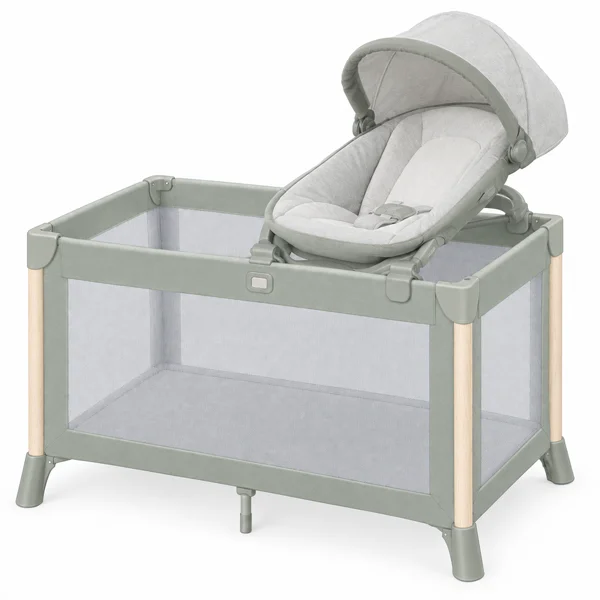
Don’t assume a napper, lounger, rocker, or similar attachment is safe for sleep simply because a baby can lie in it.
These accessories can look very similar to a bassinet, but they may be designed for supervised use while the baby is awake, rather than unattended or overnight sleep.
If the manufacturer does not identify the accessory as a sleep product or specifically instruct you to use it for infant sleep, don’t use it as your baby’s sleep surface.
4. Changer
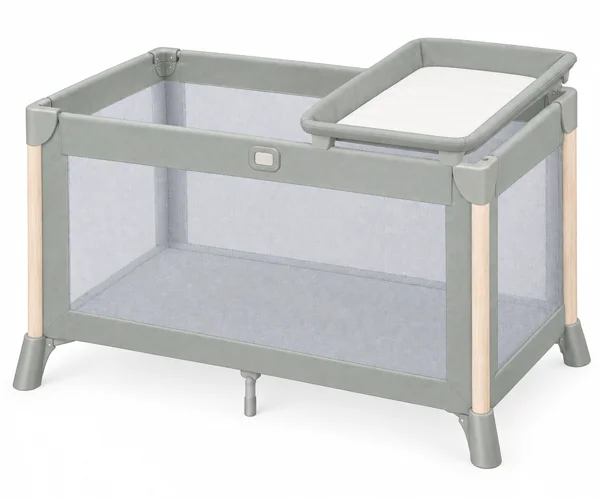
A changing table is designed for diaper changes, not sleep.
Even when it attaches securely to the playard, it should never be used as a bassinet or substituted for an approved infant sleep surface.
The simplest rule is: look at what the manufacturer says the specific attachment is designed and approved for, not just what the attachment looks like.
How to Use a Pack ’n Play Bassinet Safely
Once you’re sure the attachment is meant for infant sleep, it’s just as important to set it up and use it properly.
1. Attach the bassinet exactly as instructed
The bassinet should be fully and securely attached before your baby uses it.
Don’t try to make your own fixes with straps, clips, extra padding, or other parts.
If a component is missing, damaged, or does not lock into place correctly, do not use the bassinet until the issue has been resolved.
2. Use the correct mattress or pad
Use only the mattress or pad specified for that particular bassinet or playard.
Do not add a second mattress, topper, cushion, blanket, or other padding to make the surface softer or more comfortable.
If you’re considering an aftermarket mattress, make sure it’s specifically approved for use in your play yard or its bassinet attachment.
Just because a mattress fits inside the bassinet doesn’t mean it’s the right or safe choice.
RELATED: Can You Put a Crib Mattress in a Pack ’n Play
3. Keep the sleep surface flat
A baby’s sleep surface should be firm and flat.
The AAP recommends placing babies on a firm, flat sleep surface in a crib, bassinet, portable crib, or play yard that meets CPSC safety standards. The AAP also advises against sleep surfaces inclined more than 10 degrees.
Do not add wedges or other products to change the angle of the bassinet unless they are specifically part of the manufacturer’s approved design.
4. Follow the bassinet’s weight and developmental limits
Check your model’s limits. There may be a maximum weight, an age range, or specific developmental milestones. For example, you’ll likely need to stop using the bassinet once your baby can roll over, push up on their hands and knees, or reaches another milestone listed in the instructions.
5. Keep the bassinet empty for sleep
Keep the sleep space clear. Do not place pillows, blankets, bumpers, stuffed animals, positioners, or any other soft or loose items inside the bassinet.
Both the CPSC and AAP recommend keeping the baby’s sleep space free of these items to reduce the risk of suffocation and other sleep-related hazards.
6. Follow Baby Safe Sleep Recommendations
A Pack ’n Play bassinet should be used as part of a safe sleep environment. Follow the same basic safe sleep recommendations you would use with any other infant sleep space.
For a complete overview of safe sleep recommendations, see our guide to safe sleep for babies.
When Should You Stop Using a Pack ’n Play Bassinet?
Stop using the bassinet as soon as your model’s instructions say to. Don’t wait until your baby physically outgrows it.
The limits might be based on:
- maximum weight
- age
- rolling
- pushing up on hands and knees
- another developmental milestone
- or a combination of these limits
Even if your baby still fits inside, it’s not safe to keep using the bassinet past those limits.
The CPSC generally says bassinets and cradles shouldn’t be used beyond about 5 months or once a child can push up on their hands and knees, but always go by the specific instructions for your Pack ’n Play bassinet.
What Should You Use After Your Baby Outgrows the Bassinet?
When your baby reaches the bassinet’s limit, move them to the lower playard sleep surface.
You do not need to replace the entire Pack ’n Play just because the raised bassinet has been outgrown.
If you’re deciding between a playard and a crib as your baby’s longer-term sleep space, see our guide to crib vs. Pack ’n Play.
If you’re specifically wondering whether a newborn can sleep in the lower playard without the raised bassinet, see our guide to whether a newborn can sleep in a Pack ’n Play without a bassinet.
And if you’re unsure how long the lower playard can be used for sleep, see how long a baby can sleep in a Pack ’n Play.
The Bottom Line
A Pack ’n Play bassinet can be a safe sleep space when the specific attachment is designed for infant sleep and is used exactly as the manufacturer instructs.
The important questions are not simply whether the product is called a “bassinet” or whether it attaches to a Pack ’n Play. Check that the attachment is intended for sleep, properly installed, used with the correct mattress or pad, kept flat and empty, and discontinued when your baby reaches its weight or developmental limits.
For general Pack ’n Play safety, see our guide to whether a Pack ’n Play is safe for your baby.