Last Updated on October 8, 2026
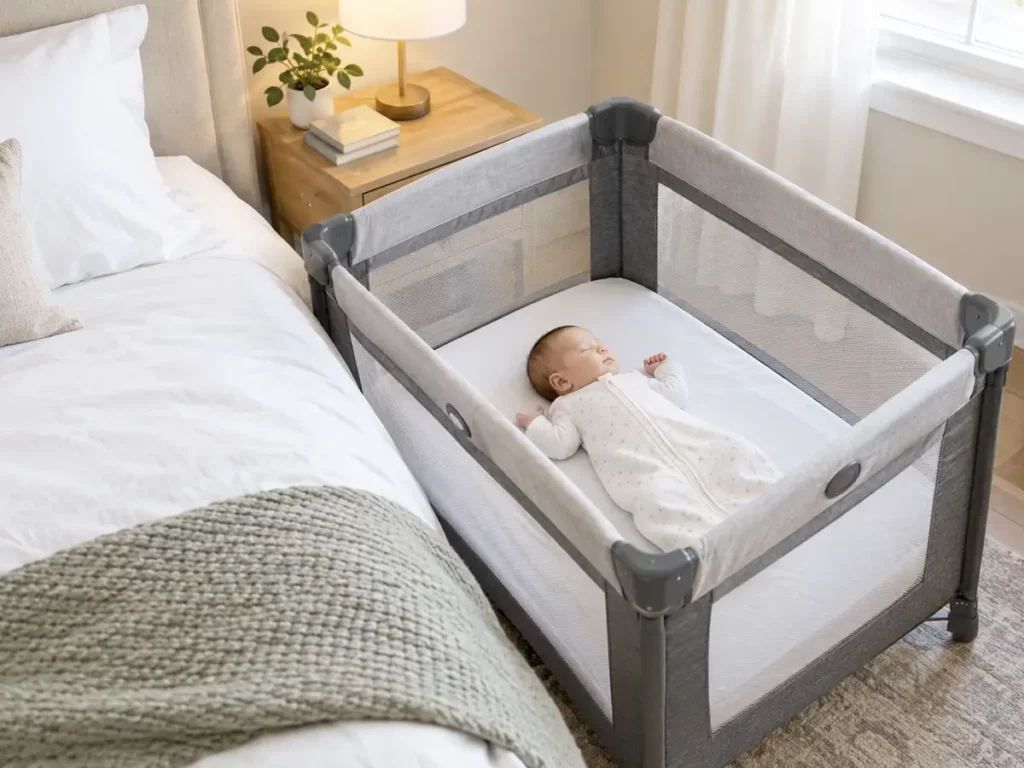
Wondering if your newborn can sleep in a Pack ’n Play? Yes — a Pack ’n Play can be used for newborn sleep when it is designed for infant sleep and used according to the manufacturer’s instructions.
A Pack ’n Play is a type of playard (also called a play yard) with a frame, floor, and mesh or fabric sides. The American Academy of Pediatrics (AAP) recognizes playards as one of the safe sleep spaces for infants. In the U.S., play yards must also meet federal safety requirements overseen by the Consumer Product Safety Commission (CPSC).
But even a compliant playard needs to be used correctly to provide a safe sleep space for your newborn.
- What Makes a Pack ’n Play Safe for Newborn Sleep?
- What if the Pack ’n Play mattress feels too hard?
- Does a Newborn Need the Pack ’n Play Bassinet?
- Which Pack ’n Play Attachments Are Safe for Newborn Sleep?
- What Should Your Newborn Sleep In?
- Where Should You Put a Pack ’n Play for Newborn Sleep?
- What About a Lightweight Travel Pack ’n Play Without a Bassinet?
- Is a Pack ’n Play as Safe as a Crib for a Newborn?
- What About an Older or Secondhand Pack ’n Play?
- Newborn Pack ’n Play Safe-Sleep Checklist
What Makes a Pack ’n Play Safe for Newborn Sleep?
Many parents think of Pack ’n Plays as something you bring along for travel or use for the occasional nap because they’re so portable. But portability doesn’t mean your playard is only for travel, short naps, or playtime.
If your Pack ’n Play has a sleep surface intended for infant sleep, it can be used for both naps and overnight sleep.
For your newborn, the playard’s sleep surface should be:
- Firm
- Flat and non-inclined
- The sleep surface designed for your particular playard
- Covered with a properly fitted sheet, if the manufacturer allows or provides one
- Free of loose bedding, pillows, blankets, positioners, and other soft objects
The safest approach is simple: use the sleep surface as intended, don’t add extra padding or another mattress, and keep the sleep space clear of soft items.
What if the Pack ’n Play mattress feels too hard?
A Pack ’n Play mattress may feel much firmer than the mattress on your own bed, but that firmness is intentional.
For newborn sleep, the surface should be firm enough to stay flat rather than mold around your baby’s head or body. A softer surface can create areas where your baby’s face may become pressed against the material.
So don’t try to make the sleep surface softer by adding foam pads, folded blankets, mattress toppers, or extra padding underneath your newborn. A mini crib mattress that seems to fit is not a safe substitute, either.
Only use the mattress or sleep surface designed for your specific playard and configuration.
Does a Newborn Need the Pack ’n Play Bassinet?
No. Your newborn does not automatically need to sleep in the raised bassinet.
Some parents worry that the lower playard surface is too large or too far down for a newborn. But if your specific Pack ’n Play is designed for newborn sleep on its lower surface, you can use it as intended. Just don’t make the sleep space smaller with rolled blankets, pillows, cushions, or positioners.
However, a raised bassinet can be convenient because it makes it easier to lift your newborn in and out of the playard.
For more information about Pack ’n Play bassinets, including their safety requirements and configuration-specific limits, see our Pack ’n Play Bassinet Safety guide.
Which Pack ’n Play Attachments Are Safe for Newborn Sleep?
Modern playards can come with several accessories, including bassinets, changing tables, nappers, rockers, and loungers.
Just because an accessory comes in the box doesn’t mean it is intended for infant sleep.
| Playard feature | Safe for newborn overnight sleep? | What to know |
| Main lower sleep surface | Usually, yes | Check your playards’ manufacturer instructions to make sure the lower sleep surface is intended for use from birth. |
| Full-size bassinet | Yes | Follow the manufacturer’s weight and developmental limits, and stop using it when those limits are reached. |
| Inclined napper or rocker | No | Inclined or seated accessories should not be used as a sleep surface. |
| Changing table | No | A changing station is intended for diaper changes, not sleep. |
The CPSC warns against using inclined or seated products for infant sleep because a baby’s head can fall forward and restrict the airway.
If your newborn falls asleep in an accessory that is not intended for sleep, move them to an appropriate sleep surface as soon as you can do so safely.
What Should Your Newborn Sleep In?
Keep your newborn’s Pack ’n Play sleep space simple.
If your manufacturer allows a fitted sheet on the playard’s sleep surface, use one that is specifically designed to fit that surface and fits snugly. Don’t use a standard crib sheet just because it appears to fit.
Your baby does not need a loose blanket, pillow, or other soft item in the Pack ’n Play. If your newborn needs an extra layer, choose appropriate infant clothing or a properly fitted wearable blanket instead.
If you swaddle your newborn, always place them on their back and stop swaddling as soon as they show signs of trying to roll. Never use a weighted swaddle.
For more about Pack ’n Play sheet sizes and fit, see our guide to whether Pack ’n Play sheets are the same size as crib sheets.
Where Should You Put a Pack ’n Play for Newborn Sleep?
If your newborn is sleeping in a Pack ’n Play, placing it in your bedroom lets your baby have their own sleep space while keeping them close to you.
The AAP recommends room-sharing without bed-sharing, with your baby sleeping in their own crib, bassinet, or portable playard close to your bed, ideally for at least the first six months.
When choosing where to set up your Pack ’n Play, keep it away from potential hazards such as:
- Window-blind or curtain cords
- Electrical cords
- Space heaters
- Unstable furniture
- Objects that could fall into the playard
What About a Lightweight Travel Pack ’n Play Without a Bassinet?
A lightweight travel playard does not automatically become unsafe for a newborn just because it does not have a raised bassinet.
The more important question is whether the specific model allows a newborn to sleep on its main sleep surface.
Some lightweight travel cribs are designed for use from birth on their lower sleep surface. Others have different age, weight, or developmental requirements.
Check the manufacturer’s instructions for your exact model to confirm whether the main sleep surface is intended for use from birth and which configurations are approved for sleep.
Is a Pack ’n Play as Safe as a Crib for a Newborn?
Yes. The American Academy of Pediatrics (AAP) includes portable play yards among the safe sleep spaces for babies, including newborns. Of course, like any crib or bassinet, a playard must meet all applicable safety standards.
What About an Older or Secondhand Pack ’n Play?
Take extra care when using a secondhand playard.
Before using one for your newborn:
- Identify the exact model.
- Check the manufacturer’s instructions.
- Make sure all required parts are present.
- Inspect the frame, floor, mesh, rails, and locking mechanisms.
- Check the CPSC recall database.
- Do not use it if it is damaged or missing parts.
If you cannot verify the correct parts or instructions for a secondhand Pack ’n Play, replacing it may be the safer choice.
Newborn Pack ’n Play Safe-Sleep Checklist
Before putting your newborn down to sleep, take a quick look:
- Is the Pack ’n Play fully assembled and securely locked?
- Is this specific configuration approved for infant sleep?
- Is the sleep surface firm, flat, and non-inclined?
- Is the correct mattress or sleep pad installed?
- Is the fitted sheet approved for that sleep surface and fitted snugly?
- Is your baby placed on their back?
- Is the sleep space completely bare apart from the fitted sheet?
- Have you removed blankets, pillows, toys, bumpers, positioners, and extra padding?
- Are you following the manufacturer’s weight and developmental limits?
- If the playard is secondhand, have you checked its condition and recalls?