Last Updated on October 8, 2026
A Pack ’n Play can be part of your baby’s sleep setup for quite a while, but there isn’t one age when every child needs to stop using one.
One thing that can make this question confusing is the name itself. Pack ’n Play is Graco’s brand name, but many parents use it as a general term for playards from other brands, too. And those products don’t all have the same limits.
So, how long can a baby sleep in a Pack ’n Play? It depends on the particular playard, your child’s size, and whether your child has reached any of the developmental limits for that product.
How Long Can a Baby Use a Pack ’n Play?
The age or weight limit you see online for one playard may not apply to another. Different brands and models can have different limits, and a single playard may have more than one limit to keep track of.
Depending on the product, the instructions may give a:
- Weight limit
- Height limit
- Age limit
- Developmental limit, such as being able to climb out
- Accessory-specific limit, such as a lower weight limit for a bassinet
That means there isn’t a universal rule like “30 pounds” or “2 years old” that applies to every Pack ’n Play or playard.
Here’s how three popular playards handle their limits:
| Model | Playard / Main Sleep Surface |
|---|---|
Graco Pack ’n Play Close2Baby Lux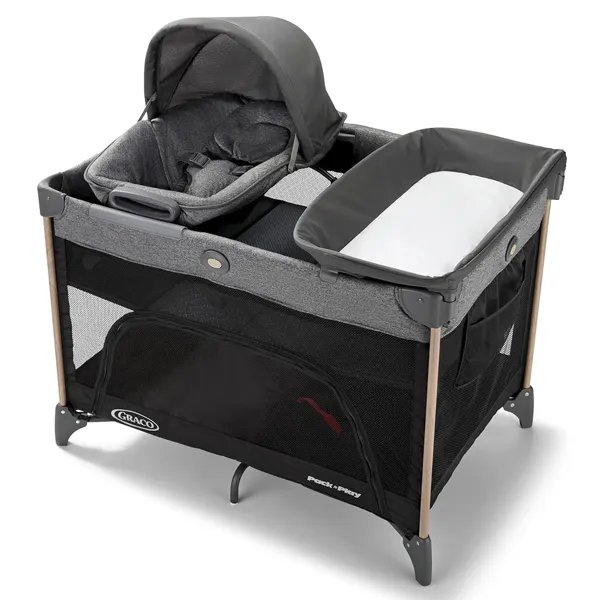 | From birth to 35 inches, 30 pounds, or until the child can climb out — whichever comes first. |
UPPAbaby REMI | From birth to 35 inches tall, or until the child can climb out. No separate weight limit is listed. |
Guava Lotus | From newborn to children under 35 inches, or until the child can climb out. There is no weight limit because the mattress is supported by the floor. |
The differences are worth noticing. Graco uses height, weight, and a developmental milestone for the playard. UPPAbaby uses height and development, without listing a separate playard weight limit. Guava takes a different approach altogether because the Lotus mattress rests directly on the floor, so the company does not set a weight limit for the crib.
In other words, a playard doesn’t necessarily need a weight, height, age, and developmental limit all at once. The manufacturer may use one of these, several of them, or a combination that makes sense for that particular design.
How Long Can a Baby Use a Pack ’n Play Bassinet?
If your Pack ’n Play includes a raised bassinet, it will usually have its own limits, and your baby will normally outgrow the bassinet before they outgrow the lower playard.
For the three playards mentioned above, the bassinet limits are as follows:
| Model | Bassinet |
|---|---|
| Graco Pack ’n Play Close2Baby Lux | Up to 15 pounds or until the baby begins pushing up on hands and knees, whichever comes first. |
| UPPAbaby REMI | From birth to 20 pounds or until the baby begins pushing up on hands and knees, whichever comes first. |
| Guava Lotus | The optional bassinet is for newborns up to 18 pounds, or until the baby can push up on their hands and knees or sit unassisted. |
So if your baby has outgrown the bassinet, that doesn’t necessarily mean they have outgrown the playard itself. It may simply be time to remove the bassinet attachment and use the lower sleep surface, if the playard is approved for your child at that stage.
For more detail on when and how to stop using a raised bassinet, see our guide to Pack ’n Play bassinet safety.
What If Your Child Is Under the Weight Limit but Can Climb Out?
This is where things get a little more interesting.
A child can still be well below a playard’s weight or height limit and no longer be ready to use it. Development matters, too.
For example:
- Your child is under the weight limit but has figured out how to climb over the side.
- Your child is under the height limit but has reached the maximum weight.
- Your child is younger than the listed age but has already reached a height, weight, or developmental limit.
- Your child is older than the suggested age but is still small and hasn’t started climbing.
You don’t want to create your own formula by combining these numbers. If your child reaches any applicable stop-use limit for that particular product, that is the limit that matters.
This is also why a child’s age by itself doesn’t tell you how long they can sleep in a Pack ’n Play. Two children the same age can be at very different points developmentally.
Does the CPSC 35-Inch Limit Mean You Have to Stop at 35 Inches?
You may come across the number 35 inches when researching playards, and it can be confusing.
The U.S. Consumer Product Safety Commission (CPSC) defines a play yard as a framed enclosure with a floor and mesh or fabric sides that provides sleeping or playing accommodation for a child who cannot climb out and is less than 35 inches tall. Play yards are regulated under 16 CFR Part 1221, which incorporates ASTM F406 with CPSC modifications.
That does not mean every playard has a universal “35-inch expiration date” that overrides the product’s own instructions.
Instead, the 35-inch figure is part of the federal definition and regulatory framework for play yards. Individual manufacturers can provide specific use limits for their products, which may include height, weight, age, or developmental milestones.
That distinction is important because you may otherwise see “35 inches” online and assume it is the only number you need to know.
A Quick Reminder About Safe Sleep
Once your baby is sleeping in the playard, the same basic safe-sleep rules still apply.
The American Academy of Pediatrics (AAP) says that a playard is a safe place for your baby to sleep—as long as it meets current safety standards, just like a crib or bassinet. What matters most is that your baby sleeps on a firm, flat surface with a tight-fitting sheet made specifically for your playard.
Keep the sleep space totally clear: no pillows, blankets, stuffed animals, bumpers, or anything soft. And don’t add extra mattresses, pads, or anything that didn’t come with your playard. That way, your baby has the safest sleep setup possible, exactly as the AAP recommends.
If you want a more detailed look at safe sleep in a Pack ’n Play, see “Is a Pack ’n Play Safe for Baby“.
What Should You Use After Your Child Outgrows the Pack ’n Play?
Eventually, every child reaches the point where a playard is no longer the right sleep space.
For many families, the next step is a full-size crib, especially a convertible crib that can later become a toddler bed or another bed configuration. This can be a practical choice if you want one sleep space that will last for years.
Some families move to a toddler or junior bed instead, depending on the child’s age, development, and readiness. A properly designed guardrail may be appropriate for some children, but the right transition depends on the individual child and the bed being used.
The important thing is not to rush the transition simply because your child has reached a certain birthday. Look at the reason they have outgrown the playard and choose the next sleep space accordingly.
If you’re deciding between keeping a playard and moving to a crib, our “Crib vs. Pack ’n Play guide” can help you compare the two.
Bottom Line
There’s no single age when every baby needs to stop sleeping in a Pack ’n Play. The right stopping point is based on the limits for your specific playard, along with your child’s size and development.
The bassinet may be outgrown much earlier than the lower playard, so treat those as separate stages. And once your child reaches a manufacturer’s stop-use limit or can climb out, it’s time to move on to the next sleep space.