
Last Updated on March 28, 2026
Updated: March 2026
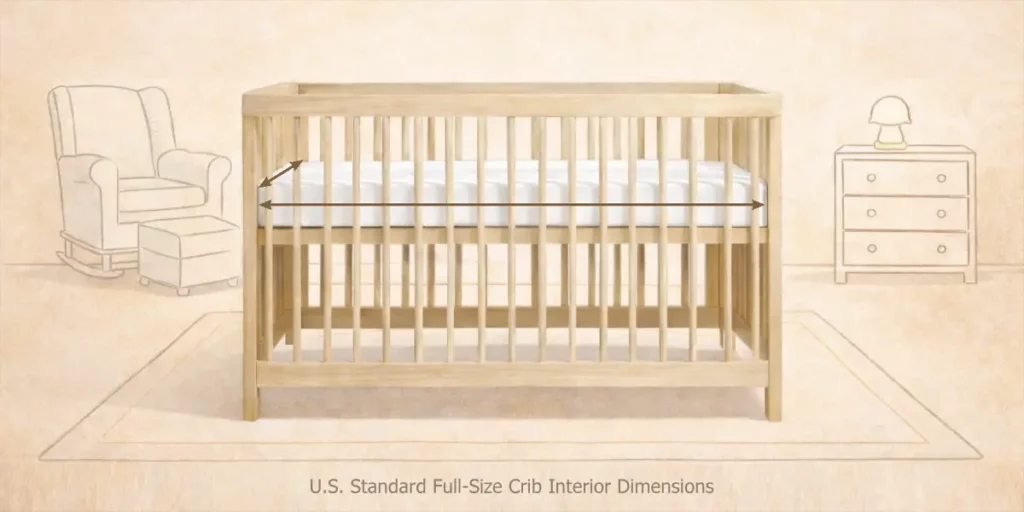
If you’re searching for baby crib dimensions, here’s the clear answer first:
A standard (full-size) crib in the United States must have interior dimensions of:
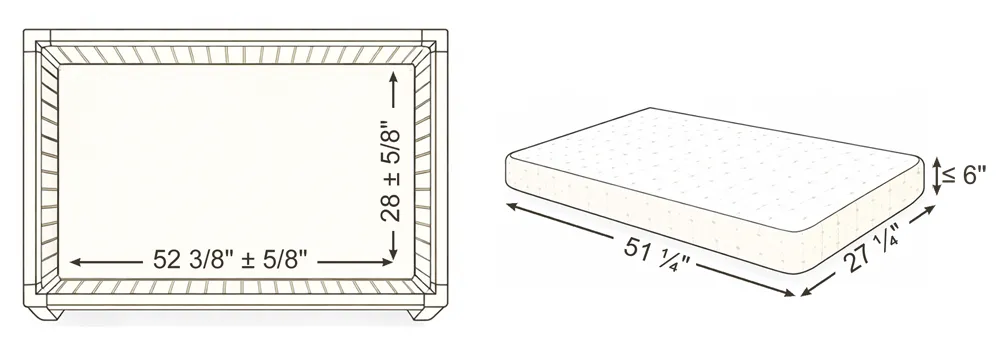
- 28 ± 5/8 inches in width
- 52 3/8 ± 5/8 inches in length
To simplify, the inside sleeping space is approximately 28 inches by 52 inches, with a small allowed tolerance range. These measurements are not random; they are defined by U.S. federal law!
Let’s break down exactly what that means.
- What Is a Standard Crib Size?
- Official Standard Crib Dimensions in the U.S.
- How Standard Crib Mattresses Fit Into These Dimensions
- Internal vs. External Baby Crib Dimensions
- Types of Cribs That Use Standard Crib Dimensions
- Are Standard Crib Dimensions the Same as Pack ’N Plays?
- Quick Summary: Standard Crib Size at a Glance
What Is a Standard Crib Size?
A standard crib is the same as a full-size crib. It is the most common crib size in the U.S., and the one most families choose for their nursery.
When manufacturers say “standard size,” they’re referring to cribs that meet federal safety and dimension regulations.
And here’s the key point: Standard size refers to the interior sleeping space—not the crib’s outer footprint.
That distinction matters, especially if you’re planning a small nursery.
Official Standard Crib Dimensions in the U.S.
Full-size baby crib dimensions are legally defined under federal regulation 16 C.F.R. Part 1219, enforced by the Consumer Product Safety Commission (CPSC).
According to the regulation, a full-size crib must have interior dimensions of:
- 28 ± 5/8 inches in width (71 ± 1.6 centimeters)
- 52 3/8 ± 5/8 inches in length (133 ± 1.6 centimeters)
This means the interior sleeping space must fall within a small allowed tolerance range for safety compliance. These standards became mandatory when strengthened federal crib safety regulations took effect in 2011 under the Consumer Product Safety Improvement Act, following the nationwide ban on drop-side cribs.
All legally manufactured full-size cribs sold in the U.S. must meet these interior size requirements!
How Standard Crib Mattresses Fit Into These Dimensions
Since all full-size cribs share the same regulated interior size, crib mattresses are manufactured to fit those exact measurements.
A standard crib mattress must measure at least:
- 27 ¼ inches wide
- 51 ¼ inches long
- No more than 6 inches thick
When placed inside a full-size crib that meets federal safety standards, the mattress should leave no more than a two-finger gap between the mattress and crib frame. This tight fit helps prevent dangerous gaps where a baby could become trapped.
If you’re using older or secondhand products, double-check sizing carefully—especially if they were manufactured before 2011. We always tell parents to check the safety labels before buying a crib.
Internal vs. External Baby Crib Dimensions
This is where many parents get confused.
1. Internal Dimensions (Standardized)
The interior dimensions do not change from one manufacturer to another — that consistency is what ensures mattress compatibility and safety.
2. External Dimensions (Not Standardized)
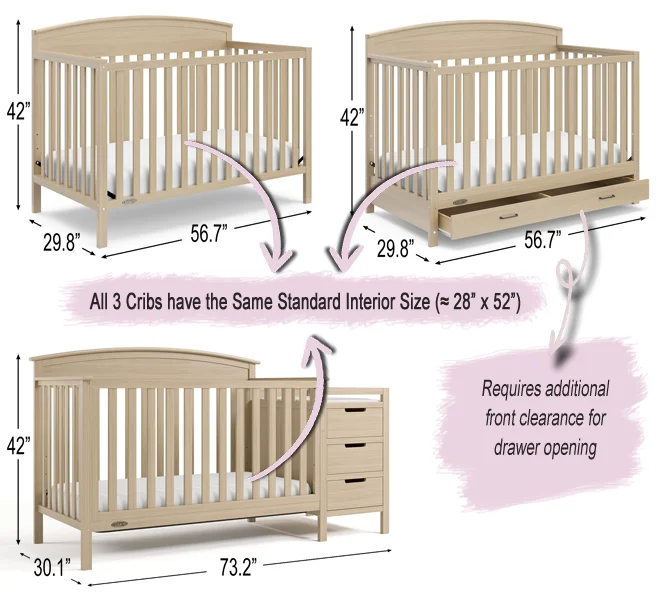
The outer size of the crib, however, is not regulated and can vary by several inches depending on the design. Exterior dimensions depend on factors like frame thickness, materials (solid wood, metal, acrylic panels), decorative details, and whether the crib includes added features such as a changing table or storage.
For example, a sleek convertible crib with slim rails may have a smaller overall footprint, while a crib with thick decorative panels will take up more space. A combo crib with an attached changing table will be noticeably longer, and some full-size folding cribs are designed with slightly narrower frames to fit through doorways more easily.
So while the interior mattress space is standardized by law, the amount of floor space the crib takes up in your nursery can vary quite a bit.
If you’re working with limited space, always check the full exterior dimensions before purchasing.
Types of Cribs That Use Standard Crib Dimensions
“Standard size” doesn’t refer to one single crib style.
Several types of cribs use the same regulated interior dimensions:
- Traditional non-convertible cribs
- Convertible cribs (2-in-1, 3-in-1, 4-in-1, etc.)
- Combo cribs with attached changing tables
- Some full-size portable or folding cribs
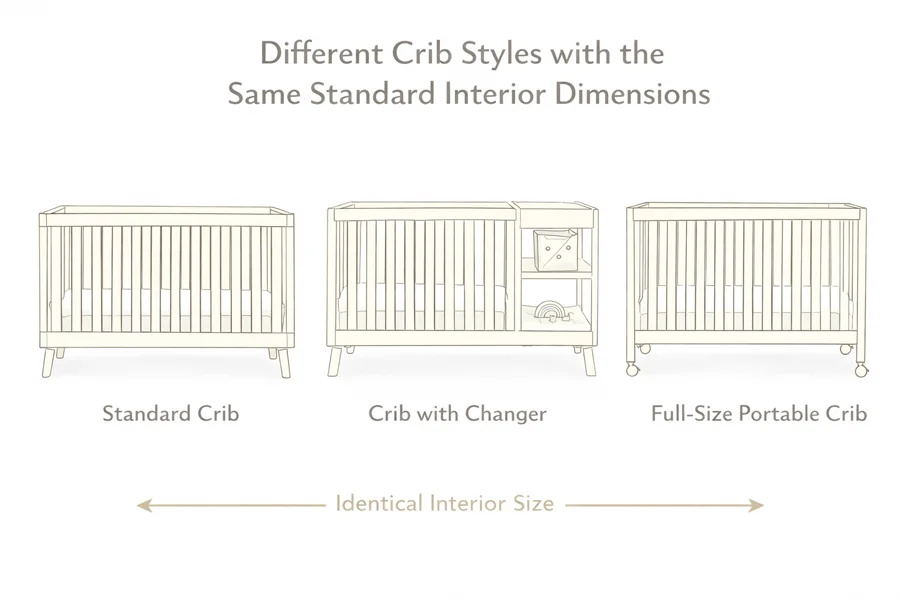
The difference between these types is the footprint—not the mattress area.
If you’re deciding between crib sizes, you may also want to compare mini crib vs. standard crib dimensions for a practical side-by-side breakdown.
Are Standard Crib Dimensions the Same as Pack ’N Plays?
No, they are not the same!
Playards (often called Pack ’N Plays, a popular product line by Graco) are smaller than full-size cribs and do not use standard crib mattresses. They include thinner, specifically designed mattress pads.
You should never place a standard crib mattress inside a Pack ’N Play. Standard crib mattresses are larger and thicker than playard sleep surfaces and can create compression, instability, or hazardous gaps that increase the risk of suffocation or entrapment.
Mini cribs are also smaller than standard cribs and use different mattress sizes.
Quick Summary: Standard Crib Size at a Glance
- A standard crib is the same as a full-size crib.
- Interior dimensions are regulated at approximately 28” x 52”.
- These federal safety standards have been mandatory since 2011.
- Standard crib mattresses must measure at least 27 ¼” x 51 ¼”, with a maximum thickness of 6”.
- Exterior crib dimensions vary by design and style.
- Standard cribs are larger than mini cribs and Pack ’N Plays.